Project information
About Word Hunt Solver
A practical tool for solving a board, understanding its paths, and practicing the words you missed.
Purpose and ownership
Word Hunt Solver is the independent KevinGu/word-hunt-solver project. It combines local screenshot recognition, deterministic word search, and practice built around a shared rule and dictionary model. The source repository is KevinGu/word-hunt-solver; access depends on its current visibility.
How we make a claim
Published results should identify their sample, software version, method, and limitations. Synthetic image tests check software behavior; they do not establish accuracy on screenshots from a real game. Simulated mobile viewports check layouts; they do not establish performance on phones.
Independent from GamePigeon
We are not affiliated with, endorsed by, or maintained by GamePigeon or Apple. Game names identify compatibility questions. Larger grids are Custom Word Hunt, and our practice scoring is a site rule. We do not distribute an official game dictionary or guarantee acceptance in a particular app.
Review and corrections
Read the dictionary specification, test methods, and release record. Use contact to prepare a correction or bug report with a preview before sending it elsewhere.
Practical details and worked examples
Questions about Word Hunt Solver often begin with what the tool actually does. It takes a confirmed square letter board, searches a named dictionary under visible custom rules, and shows reproducible routes. It also offers local screenshot review and practice. This is an independent project, not an official GamePigeon service, and its source delivery should not be confused with a verified live deployment or a game-certified vocabulary.
Make the answer explainable
A useful local learning tool provides more than a list of spellings. Each selected answer shows where to start, which touching cells to use, and how the route turns. Step numbers and arrows complement color. The independent validator checks the construction, while the named dictionary defines membership. That separation lets a user investigate a surprising answer rather than accept an unexplained claim that it is valid in every game.
Use solving as the beginning of learning
Practice turns an inspected board into a challenge you can replay without looking at its answer list. Daily, random, custom, and themed rounds support different goals. Review compares found words with the completed or explicitly unfinished search and highlights paths worth revisiting. A paused or untimed session can be a valuable lesson, but it should retain that status instead of appearing as a strict timed achievement.
Keep processing deterministic and visible
The search uses a Trie and depth-first exploration with prefix pruning. Screenshots are cropped, split into cells, and matched locally before mandatory human review. Neither workflow needs a cloud language model to invent letters or words. When reading about Word Hunt Solver, distinguish those implementation choices from performance or accuracy claims: deterministic processing is inspectable, but real-device behavior still requires actual testing in the named environment.
Credit resources without borrowing official status
The independent ENABLE source has recorded authorship, dedication evidence, version, and checksum. Optional OCR uses self-hosted Tesseract resources with preserved licenses, while generic templates request installed fonts without bundling font files. These resource rights do not authorize proprietary screenshots or game branding. A Word Hunt helper can explain its sources responsibly without describing an independent word list as official or claiming that a third-party code license covers every bundled asset.
State the current verification boundary
Questions about Word Hunt Solver verification should distinguish implementation checks from external observations. The implementation includes behavior tests and recorded desktop and narrow-viewport browser checks. Those checks do not substitute for authorized current-game captures, installed-game word acceptance, or physical iOS and Android devices. Large grids are supported Custom Word Hunt modes. Ordinary hosting downloads still occur even though screenshot pixels are processed locally. Current limits are documented so a future improvement can be evaluated against an honest baseline rather than a marketing promise.
A practical sequence
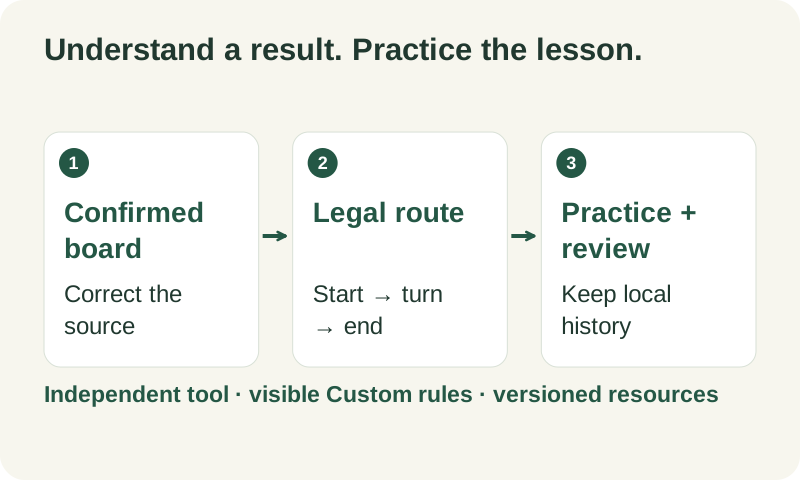
- Confirm the board and read its custom rule summary.
- Inspect a suggested word through its numbered route.
- Practice the board without the answer list and review selected misses.
- Use resource and benchmark pages when a claim needs supporting evidence.
A worked example
A user uploads a supported screenshot, corrects an uncertain Q, and solves the confirmed 4×4 board. Selecting CAT reveals its start and turn. The user can then practice that same board, finish a round, and review the missed route in local history. This chain demonstrates the intended product purpose: understandable assistance followed by deliberate practice. It does not establish that the original image was recognized automatically or that CAT was tested in a current version of another game.
What to carry into your next attempt
For further questions about Word Hunt Solver, consult the relevant rule, dictionary, privacy, and benchmark page before assuming an affiliation or capability. The project aims to make its inputs, decisions, and recovery paths understandable. Stronger compatibility or performance statements should follow authorized evidence and a recorded version change, not precede them.
Check the selected rules and custom points, word-list source and license, verification methods, and local data and network details when interpreting this example.
Updated October 10, 2026 · Independent Word Hunt Solver project