Build a repeatable word-finding habit
Word Hunt practice
Play first, then see the missed words and their paths. Choose a daily challenge, a fresh evaluated board, or a focused drill. All four board sizes work with the same transparent site rules.
Set up your practice
Custom rules · 4×43+ letters8 directionsQ = Q
Each tile is used once per word. Site word list and scoring are independent of GamePigeon.
Word list & rule versions
Word list: enable1 v1. Rules: custom-4 1.0.0. Scoring: length-v1. GamePigeon word acceptance and scoring are not verified.
Pausing marks the session as paused. Its score stays separate from uninterrupted timed records.
Prepare a board before starting. No answers are shown during practice.
How practice works
Prepare a board, check the rules, and start a three-second countdown. Connect neighboring tiles without reusing a tile. Accepted words appear in your own list; the answer list stays hidden until you finish. Timed sessions keep running in background tabs. Pausing is allowed and visibly marks the record.
After the session, compare found and missed words, inspect numbered paths, and replay the same board or selected missed words. Device history is optional. The site’s word list and scoring are independent of GamePigeon; larger boards are Custom Word Hunt.
Practical details and worked examples
Choose word hunt practice according to the skill you want to change. The site offers a shared daily board, fresh generated boards, your own exact letters, and five focused training themes. Each mode supports the same four grid sizes and explicit Custom rules. You can play with the selected timer or without a deadline; either way, the aim is to connect legal paths and understand what you missed, rather than merely accumulate an unexplained total.
Choose a repeatable challenge
Daily word hunt practice gives a date-based board for each size. Random mode generates a new challenge, while custom mode preserves an input you want to investigate. Focused drills narrow the objective to short words, long words, families, turns, or scanning. Start with a familiar four-row size if reading paths is still difficult. A larger grid is a different search workload, not automatically a better lesson or an official mode of another game.
Select conditions you can compare
Before starting, choose minimum length, adjacency, Q behavior, and timer mode. Eight-direction movement allows diagonal neighbors; orthogonal movement does not. An explicit QU tile contributes two letters in one step. The site’s custom length-based points are transparent but not verified GamePigeon scores. Keeping these choices fixed makes a later retry interpretable. Changing several conditions at once can improve the number without showing which skill actually improved.
Submit a route and read the feedback
In word hunt practice, build the word from adjacent tiles, with each position used at most once in that submission. The spelling is derived from the route, not a free-form word guess. Feedback distinguishes illegal movement, duplicate submissions, dictionary membership, and a valid word that does not match a drill target. Treat that feedback as a diagnostic. If a familiar spelling fails, inspect the exact path and the selected rule before assuming the dictionary is wrong.
End with a focused review
Word hunt practice review reveals found and missed dictionary words, their legal paths, and routes worth retrying. A search that stopped at its budget cannot establish the entire missed set; check the review’s completion status. Select one actionable gap: an adjacent short word, a suffix you overlooked, or a corner where you never started. Replay the same board to practice that decision. Reading an enormous missed list without choosing a goal usually creates more information than a useful lesson.
Save history only when it helps
Local history is optional, and its records preserve the board and rule context required for comparison. A paused round is marked so it is not mistaken for strict timed performance. Import and export let you keep your own copy, and deletion removes the selected local records. History is a personal learning aid, not a public leaderboard. You do not need an account or a claim about an average player’s score to assess your own repeatable progress.
A practical sequence
- Pick daily, random, custom, or a focused drill.
- Set one grid size and keep the rule profile stable.
- Choose a timer or an untimed discovery round.
- Submit paths and use specific feedback to correct mistakes.
- Review one missed skill, then retry that same challenge.
A worked example
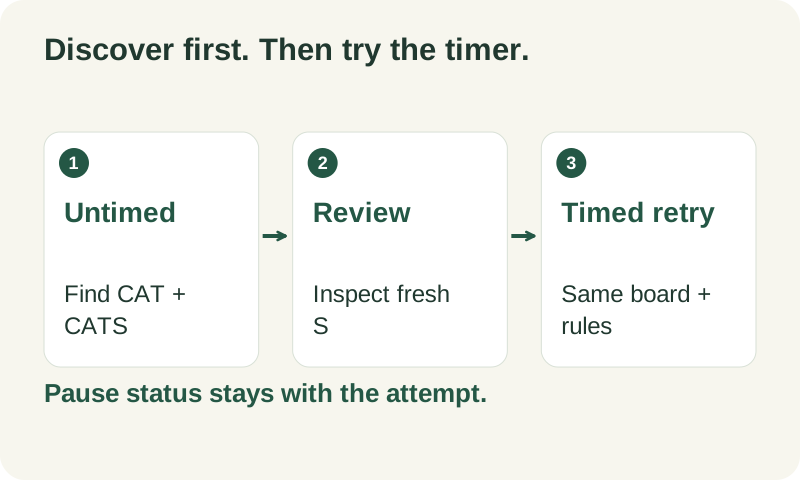
Try an untimed starter board, find CAT, and notice a nearby S that could extend it to CATS through a distinct adjacent tile. Verify the longer route rather than assuming the family is accepted. Then replay with a timer and see whether you recognize the same extension without looking at review. This word hunt trainer exercise isolates a concrete skill: extending a known base while keeping the entire path legal.
What to carry into your next attempt
Useful word hunt practice pairs an observable objective with a controlled retry. Keep the board, dictionary, timer, and pause status in view when comparing records. Once a particular pattern becomes reliable, move to a fresh board to see whether the lesson transfers. A larger random score by itself does not demonstrate that transfer.
Check the selected rules and custom points, word-list source and license, verification methods, and local data and network details when interpreting this example.