Project information
Word Hunt changelog
Versioned changes to the product, rule profiles, dictionaries, and recognition resources.
October 10, 2026 · Source release 1.0.0
The initial complete source implementation introduces 4×4 through 7×7 solver workspaces, local screenshot review, numbered paths, and versioned rule profiles. Practice includes daily, random, custom, and five theme modes, with review and local history. Board sharing previews a rule-and-board copy without screenshot or history attachments.
Rule and dictionary baseline
Custom Word Hunt rules use eight-direction adjacency by default, no tile reuse, a configurable minimum length, and literal Q or Qu. The length-v1 practice score is 100 points per letter after the second. ENABLE1 v1 is self-hosted with a source fingerprint and separate public-domain dedication evidence. These rules and words have not been verified against a current installed GamePigeon version.
Recognition baseline
The local recognizer uses geometry candidates, cell preprocessing, template matching, and explicit letter review, with an optional local OCR fallback. Local templates 1.1.0 were checked on three public-source GamePigeon UI images: two development images and one separate-source held-out image. Primary recognition left one unknown cell and no wrong letters; one manual correction recovered all three boards. Original device and game version remain unverified. Local OCR now presents explicit per-cell suggestions without overwriting primary recognition. Synthetic regressions and these small-sample observations are reported separately, without a general accuracy claim.
How future changes are recorded
A dictionary or rule change must carry a new version when it changes accepted words or scores. History comparisons remain grouped by matching versions. Recognition changes should name the template/model version and report separate automatic and manually corrected outcomes. See validation methods and the repository’s validation document for measured build results.
Practical details and worked examples
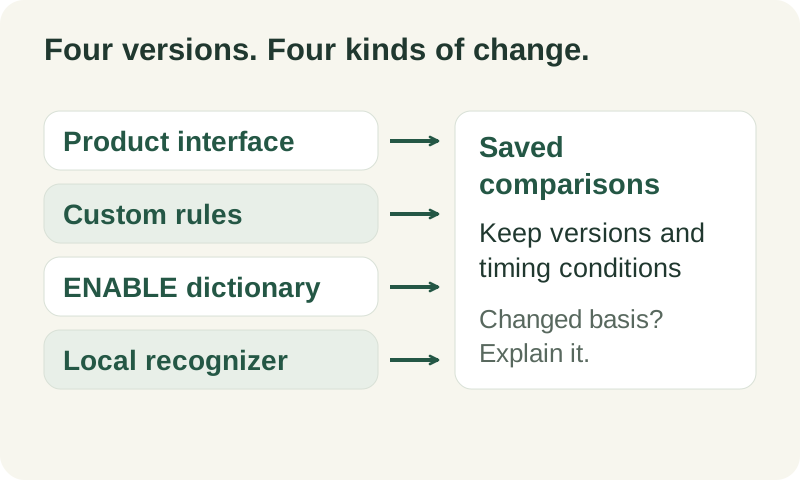
The release history records behavior changes by product, rule, dictionary, and recognizer version. These identifiers answer different questions: an interface update can improve controls without changing words, while a vocabulary update can change results on the same letters. The initial source release is dated October 10, 2026. It documents an implementation and its evidence, not an automatic claim that a production site has already been deployed.
Read the initial implementation scope precisely
The initial Word Hunt Solver changelog describes a delivered tool that supports four square sizes, local screenshot correction, legal numbered paths, sorting and filtering, and practice with local review and history. Daily, random, custom, and five themed modes have distinct tasks. Sharing previews a board-and-rule copy. Listing those implemented capabilities does not prove official-game compatibility or real-phone performance. The release record should keep functionality and externally validated behavior in separate sentences so readers can assess each claim.
Track rule changes as changes to the challenge
The Word Hunt Solver changelog records custom profile version 1.0.0, which defaults to eight-direction movement, a three-letter minimum, no tile reuse, literal Q, and an optional 90-second site timer. Length-v1 assigns 100 points per letter after the second. A future change to those semantics can affect legality, points, or comparisons even when the interface appears familiar. Record the affected setting and version rather than placing a score-changing update under an unexplained “improvements” heading.
Identify dictionary bytes rather than a vague name
ENABLE 1 v1 contains the recorded 172,823 entries, with a pinned source and checksum. The Word Hunt Solver changelog should distinguish a replacement vocabulary file from a faster Trie build using the same bytes. A changed word resource needs its own identifier or version because result counts and possible practice points can change. Credits and dictionary permission evidence remain resource-specific; a general software update does not alter their meaning.
Describe recognition changes with their review policy
The local-templates-1.1.0 revision improves board geometry, glyph topology, and overlay handling while retaining mandatory cell review. Optional Tesseract resources keep their own pinned versions. Three source-published GamePigeon UI images have independently frozen labels; two informed development and one was held out from recognizer tuning. Capture provenance and game versions remain unverified, and no physical device was tested. Keep corrected success separate from original automatic output; the OCR benchmark records both stages and their limited sample scope.
Explain the effect on saved comparisons and exports
The Word Hunt Solver changelog should explain how local records retain rule, dictionary, timing, and pause settings. When versions diverge, an older record should remain identifiable rather than be rewritten as though it used the new challenge. Unsupported imports need a clear recovery explanation and preservation of the original export. The Word Hunt solver can compare like settings, but a migration must explain any changed basis. Release notes should link observed tests and limitations rather than promises about future accuracy or rankings.
A practical sequence
- Identify whether the change affects interface, rules, vocabulary, or recognition.
- Read the exact version and the behavior that changed.
- Check whether saved records remain comparable or need a supported migration.
- Use recorded verification evidence to distinguish implementation from external validation.
A worked example
Suppose a future interface release makes the 7×7 zoom control easier to reach but keeps ENABLE v1 and custom rules 1.0.0 unchanged. Its note can describe a usability change without claiming a new vocabulary. In a different hypothetical update, replacing dictionary bytes can add or remove results on the same board and requires a resource version and comparison explanation. Neither hypothetical entry is an announcement of a completed update; it illustrates the information a meaningful release record should preserve.
What to carry into your next attempt
Read the Word Hunt Solver changelog as a record of specific behavior and evidence. Keep resource versions with results, distinguish source release from deployment, and treat implemented features separately from unmeasured game or device compatibility. Future notes should make the effect on an existing board or saved session understandable before celebrating a new version number.
Check the selected rules and custom points, word-list source and license, verification methods, and local data and network details when interpreting this example.
Updated October 10, 2026 · Independent Word Hunt Solver project