Guides
Word Hunt guides: learn the board and read the path.
Seven practical guides connect the rules to the solver and your next practice round.
Word Hunt rules and scoring
Understand adjacency, tile reuse, Q / Qu, and the limits of game compatibility.
Word Hunt dictionary: why a game rejects a solver word
Check the letters and path before comparing dictionary and game versions.
Fix Word Hunt screenshot recognition
Crop, check the grid, inspect uncertain letters, and recover from unsupported files.
Read and follow Word Hunt swipe paths
Use starts, step numbers, directions, and alternative paths without relying on color.
A practical Word Hunt training routine
Practice short words, word families, long words, turns, and systematic scanning.
Word Hunt vs. Word Search vs. Anagrams
Choose a tool based on the game's movement rules and input format.
Choose a Word Hunt board size: 4×4 to 7×7
Match the actual grid, use Custom rules for large boards, and understand partial searches.
Practical details and worked examples
Use these Word Hunt guides when a specific part of your board needs an explanation: entering letters, choosing rules, reading a path, understanding a rejected word, or deciding what to practice next. Start with the question you actually have. The articles connect an explanation to a working tool, so you can check the idea on a small board before using it during a timed round.
Choose a guide by the decision in front of you
If you cannot enter the board reliably, open the screenshot troubleshooting article first. If the board is correct but a suggested word seems impossible, use the swipe-path article. If a legal path is rejected elsewhere, read the dictionary guide. These Word Hunt tips address separate causes; changing the vocabulary list will not fix a misplaced letter, and practicing faster will not repair a wrong grid size.
Read the rules before borrowing a tactic
The rules article in these Word Hunt guides explains touching tiles, turning, minimum length, literal Q, optional QU interpretation, and this site's transparent custom points. The default permits diagonal neighbors and prevents returning to the same cell within a word. Other settings can change the legal answers. Keep the chosen profile visible while learning, because a useful tactic under eight-direction movement may fail when only horizontal and vertical moves are allowed.
Separate input mistakes from vocabulary differences
A result depends on three things: the letters entered, the allowed movement, and dictionary membership. Check them in that order. An O mistaken for Q changes the board before vocabulary is considered. An unexpected diagonal changes path legality before scoring is considered. The dictionary article in these Word Hunt guides explains how to record a genuine difference with another game after those checks. It does not promise that this site's accepted words match an external application.
Use a short path as your first worked exercise
The Word Hunt guides use numbered steps and coordinates so a route remains understandable without color. Read the start cell aloud, then describe each next neighbor. Try the same word through another route if one exists. The aim is to understand why each move is legal, rather than memorize a colored line. A longer answer is easier to follow after a three-letter example establishes the movement contract.
Choose a narrow practice objective
Useful Word Hunt tips become testable when you choose one skill: three-letter recall, extending a word family, finding a longer prefix, tracing a turn, or scanning starting cells in a deliberate order. Play an untimed round while learning the skill, then repeat with a timer if desired. Afterward, inspect a few missed words and their paths. A focused review provides a clearer next action than copying an entire answer list.
A practical sequence
- Identify whether the problem is input, rules, movement, vocabulary, or practice.
- Open the matching article and try its worked example.
- Return to the solver or a themed drill with the same rule settings.
- Finish a round and review one missed opportunity before changing topics.
A worked example
Suppose your result contains CAT but you do not see it as a straight line. On the illustrated board, C is at row 1, column 1; A is immediately to its right; T is directly below A. That turn is legal under the default rules. Open the path guide to check the steps. Only after confirming the letters and movement should you investigate a dictionary difference. This simple sequence avoids treating every confusing answer as the same kind of problem.
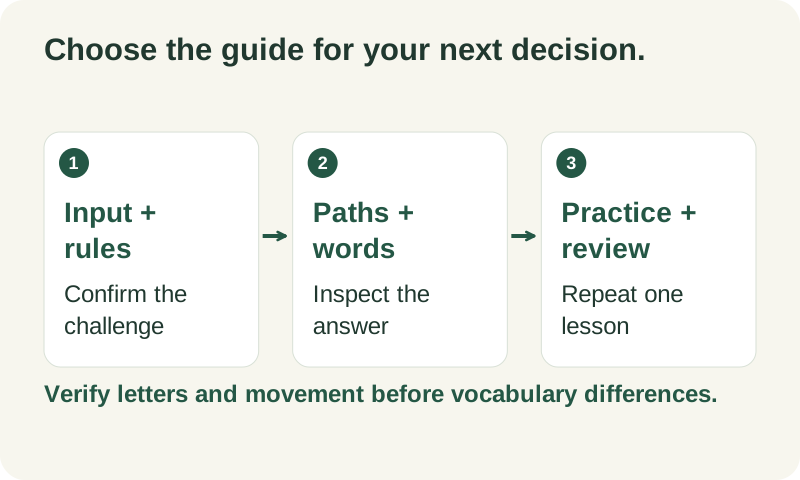
What to carry into your next attempt
Return to these Word Hunt guides when your next question changes. Use the rules article to establish the challenge, the input articles to make the board trustworthy, and the practice article to choose one repeatable exercise. The learning goal is a correct decision you can explain, with the current dictionary and rule limits visible.
Check the selected rules and custom points, word-list source and license, verification methods, and local data and network details when interpreting this example.
Updated October 10, 2026 · Independent Word Hunt Solver project