Field guide
Word Hunt rules and scoring
Understand adjacency, tile reuse, Q / Qu, and the limits of game compatibility.
One path, one word
The default Custom Word Hunt profile connects horizontally, vertically, or diagonally adjacent tiles. You may turn at each step. Each tile can appear only once in a single word, although another word can use it again. A dictionary match alone is insufficient: the displayed path must also pass these movement checks.
Read the rule summary first
Size, minimum word length, adjacency, Q behavior, scoring, timer, and dictionary version travel together. Choose orthogonal adjacency to exclude diagonal steps. With literal Q, a Q tile contributes Q; with Qu, it contributes QU while still occupying one tile. An explicit QU tile also occupies one position. Letter length and path length can therefore differ.
Our scoring is a practice rule
The length-v1 rule awards 100 points for each letter after the second: three letters earn 100 points, four earn 200, and five earn 300. These are site practice points, not a verified GamePigeon score table. A 90-second practice setting is a site default, not a claim about every game version.
GamePigeon compatibility needs version evidence
This independent tool has not verified an installed GamePigeon version, special-letter behavior, current timer, or all accepted words. The shipped presets use Custom Word Hunt rules. Large boards are Custom Word Hunt. See compatibility status before treating a solver answer as a game acceptance guarantee.
Practical details and worked examples
The Word Hunt rules on this site define a connected path through neighboring tiles. Under the default Custom profile, moves may be horizontal, vertical, or diagonal, and the route may turn. A cell cannot appear twice in one word. These settings describe this site's challenge, not verified GamePigeon behavior. Check the rule summary before solving or comparing a practice result.
Check each neighboring move independently
Number the cells by row and column rather than guessing from a line that crosses the board. Under the selected Word Hunt rules, a move is legal when the next cell touches the current one under the selected adjacency setting. With eight-direction movement, moving one row down and one column right is allowed. With orthogonal movement, it is not. Returning to an earlier cell is forbidden in either setting, even when the desired word repeats a letter.
Count letters separately from visited tiles
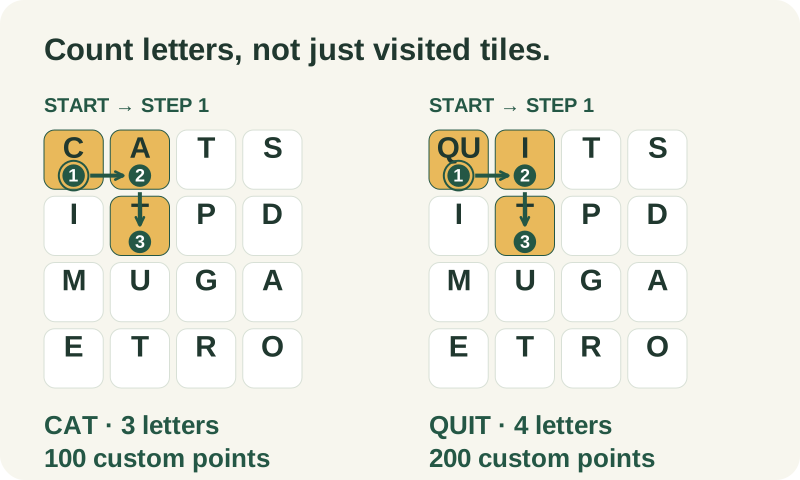
The Word Hunt rules apply minimum length to the assembled letters. The default is three letters, but the configurable minimum is shown in the profile. A tile containing QU supplies two letters while using one board position. A longer multi-letter tile similarly contributes its token without creating extra cells. This distinction matters for both accepted length and Word Hunt scoring; the number of path steps does not necessarily equal the number of letters.
Choose what a Q tile contributes
A literal Q contributes Q only. Choosing the automatic QU option makes a literal Q contribute QU; an explicitly entered QU tile already has that token. The setting changes how words are assembled, so do not silently switch it to produce a more attractive result. If another game handles Q differently, record its behavior separately. The current Word Hunt rules make the chosen interpretation visible throughout solving, practice, and review.
Calculate this site’s points transparently
The length-v1 custom formula gives 100 points for each letter after the second: three letters earn 100, four earn 200, and five earn 300. A shorter-than-minimum word cannot be submitted merely because a formula can calculate a number for it. These points are a consistent practice measure. They are not presented as official GamePigeon points, and a score comparison must retain the same dictionary, minimum length, and tile interpretation.
Keep timer and comparison settings together
The optional default practice timer is 90 seconds, selected by this site. Untimed and paused rounds serve useful learning purposes but should not be treated as strict timed records. Local history groups compatible settings and preserves pause status. To compare two attempts meaningfully, also use the same board, size, adjacency, dictionary version, and duration. Word Hunt scoring explains the points; the surrounding settings explain whether the two challenges were comparable.
A practical sequence
- Confirm size, minimum letters, adjacency, and Q interpretation.
- Follow distinct touching cells and read their complete tokens.
- Check assembled-word membership in the selected dictionary.
- Calculate custom points and retain the timer and pause status with the result.
A worked example
For CAT on the guide board, use C at row 1 column 1, A at row 1 column 2, and T at row 2 column 2. The three cells are distinct, both moves touch, and the word has three letters, so its custom score is 100. For QUIT using an explicit QU tile followed by neighboring I and T tiles, three visited cells provide four letters and 200 custom points. Neither example establishes acceptance or scoring in an external game.
What to carry into your next attempt
Apply the Word Hunt rules as a complete profile rather than a single familiar movement rule. When an answer changes after a setting switch, check the assembled letters and the affected path first. Keeping the selected settings attached to a board makes solving, practicing, and reviewing the same challenge easier to explain and reproduce.
Check the selected rules and custom points, word-list source and license, verification methods, and local data and network details when interpreting this example.
Updated October 10, 2026 · Independent Word Hunt Solver project