Dictionary specification
The Word Hunt dictionary behind the answers
ENABLE1 v1 is a transparent English game-word list. It is not an official GamePigeon dictionary.
Resource record
- Identifier
- enable1 · v1
- Entries
- 172,823
- Download
- 1,743,363 bytes · self-hosted
- Authors
- M. Cooper and Alan Beale
- License
- Public domain, with the authors’ explicit ENABLE dedication
Provenance and license evidence
The unmodified file is pinned to dolph/dictionary commit 233d25a. The separate SCOWL Copyright record at b22230c quotes the ENABLE authors’ public-domain dedication. This is license evidence for this word list, independent of another repository’s code license.
Inspect the self-hosted manifest, license excerpt, and source word list.
SHA-256: 3f16130220645692ed49c7134e24a18504c2ca55b3c012f7290e3e77c63b1a89
Selection and normalization
Runtime entries are normalized to uppercase ASCII A–Z, deduplicated, and stored in a Trie for prefix pruning. Minimum word length comes from the selected rule profile. The list is broad: obscure, dated, and inflected forms can appear. This release has one dictionary; it does not present an invented “official” or secretly filtered game list.
What a result proves
A listed answer belongs to this word list and has a validated path under the selected profile. It does not prove another game will accept it. Game-version acceptance samples are currently zero. See rejected-word troubleshooting and the compatibility method.
Version-aware review
Solver, practice, and review carry dictionary and rule versions. Local statistics compare matching versions rather than interpreting a dictionary change as skill improvement. A future word-list change should publish its new fingerprint, count, license record, and migration effect.
Practical details and worked examples
The current Word Hunt dictionary is ENABLE 1, site version v1. Its source file contains 172,823 distinct lowercase ASCII entries and is served from this site's origin. A named version and source fingerprint make results inspectable: a word is accepted here because it belongs to that resource and can be constructed legally on the selected board, not because an external game has approved it.
Trace the source and its separate permission evidence
The recorded mirror is pinned to a specific commit in dolph/dictionary. Authorship credits name M. Cooper and Alan Beale, and preserved ENABLE-specific text documents the authors' public-domain dedication of the list. This permission is separate from any software-package license. The repository's resource manifest records the exact file and checksum. A maintainer changing the vocabulary should verify those bytes and permission evidence instead of treating an unrelated open-source license as dictionary authorization.
Understand what normalization does and does not change
Source entries remain lowercase ASCII, while lookup normalizes entered letter tokens to uppercase. The Word Hunt dictionary does not obtain live suggestions from a remote definition service, infer missing letters from plausible words, or silently add a word because it is common. The runtime builds a Trie to test prefixes efficiently. That search structure speeds exploration; it does not improve, simplify, or certify the vocabulary that the source file contains.
Combine membership with a legal board construction
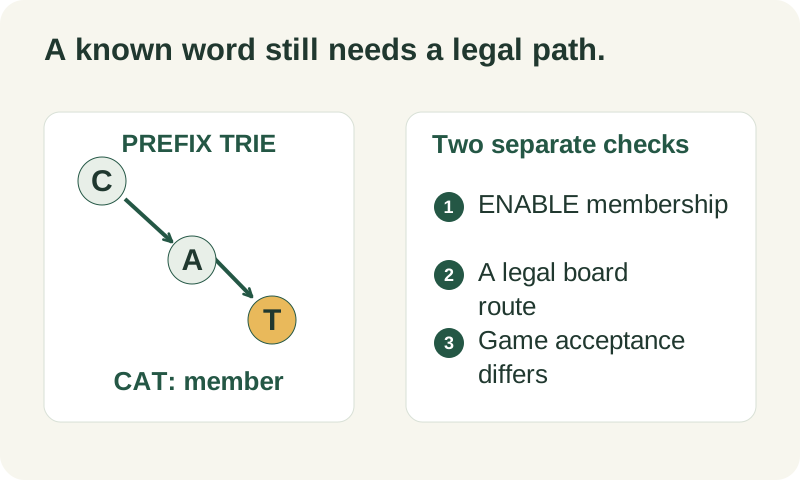
A Word Hunt dictionary entry alone is insufficient. The selected Word Hunt rules require touching distinct cells, an in-range path, the configured minimum length, and the chosen Q interpretation. The assembled token string must equal the candidate spelling. Explicit QU supplies two letters from one tile. Solver and practice share these checks, so a word that fits the list but cannot be traced on the current board is not a valid submission here.
Expect broad vocabulary rather than game certification
ENABLE includes uncommon terms, inflections, and some adult language. Its membership should not be presented as a suitability rating, a definition, or official GamePigeon acceptance. A different game may filter entries or use another versioned list. The compatibility page records the absence of authorized current-game observations. If an entry surprises you, check its spelling and legal route, then use the dictionary guide to document any external acceptance difference.
Treat vocabulary changes as versioned behavior
Adding or removing Word Hunt dictionary entries can change result counts, missed-word review, and possible practice points even when the board is identical. Keep the Word Hunt rules and dictionary identifier/version with an exported result or session. Old and new vocabulary results should not be mixed into one unexplained improvement claim. A future update needs a changed resource version and a changelog explanation; the current count is a property of the shipped file, not a forecast of another release.
A practical sequence
- Read the dictionary identifier, version, author credits, and dedication.
- Verify the source checksum and count with the repository verification script.
- Apply the current board and rule settings to each membership decision.
- Keep resource versions in reports, exports, and same-rule comparisons.
A worked example
For CAT, membership is one check and the route is another. On the guide board, C at row 1 column 1, A at row 1 column 2, and T at row 2 column 2 form a legal three-letter construction under the default profile. If you enter a different tile at T's position, the entry still exists in ENABLE but that route no longer spells CAT. Likewise, external rejection would be a separate observation about the tested game, not proof that the source file changed.
What to carry into your next attempt
Use the Word Hunt dictionary as a reproducible input to the tool. Its pinned source, count, credit, and dedication explain what is shipped and why it can be distributed. Its limitations explain what membership cannot establish. Keep those resource facts attached to legal-path results rather than describing them as an official or universally accepted vocabulary. Compare against the current Word Hunt dictionary, not an unnamed list.
Check the selected rules and custom points, word-list source and license, verification methods, and local data and network details when interpreting this example.
Updated October 10, 2026 · Independent Word Hunt Solver project