4 × 4 · short words
First steps
Start in the top row with CAT; then scan each start tile for short neighbors.
Gentle · 85 words under default site rules
Evaluate & playSelected boards with a purpose
Six fixed, selected boards cover all four sizes and different training tasks. Before you play, each is evaluated with your chosen rule profile and versioned dictionary. Difficulty describes available-word density, not official game difficulty or a measured estimate of your skill.
4 × 4 · short words
Start in the top row with CAT; then scan each start tile for short neighbors.
Gentle · 85 words under default site rules
Evaluate & play5 × 5 · turning paths
STONE across the second row gives an anchor. Expand beyond straight rows and follow diagonal neighbors.
Dense · 246 words under default site rules
Evaluate & play6 × 6 · board scanning
A larger board rewards a repeatable start-tile scan. Try one row of starting tiles at a time.
Dense · 629 words under default site rules
Evaluate & play7 × 7 · long words
Use the larger connected space to extend common starts. Long words use letters, not necessarily more tiles when QU is active.
Dense · 567 words under default site rules
Evaluate & play5 × 5 · prefixes and suffixes
After finding a base word, check adjacent S, ED, ER, and ING continuations; each extension must have its own legal path.
Dense · 329 words under default site rules
Evaluate & play4 × 4 · turning paths
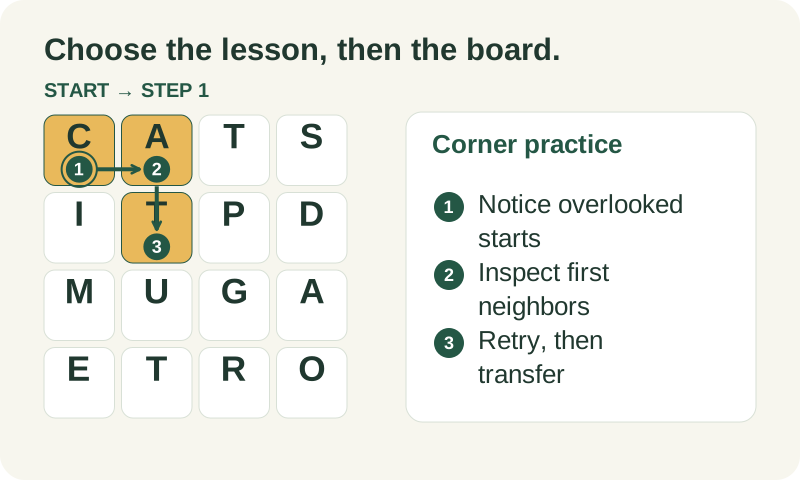
Look for short words near corners and practice changing direction without reusing a tile.
Balanced · 118 words under default site rules
Evaluate & playThe word hunt board library collects generated challenges that have been solved and editorially selected for particular learning tasks. It is a starting point for deliberate practice, not an official collection from another game. Browse by size and theme, then read the evaluation before starting. A word count describes opportunity under specified rules; it does not tell you how easy a particular player will find the board or predict an official-game score. For word hunt practice, choose a comfortable size before moving to a denser challenge with more branching positions.
Each word hunt board library entry has a recorded solver evaluation with the selected dictionary and Custom settings. Difficulty labels use observable word density and longer-word counts. They are site-specific categories, not a validated measure of human performance. Check the size and theme beside the label. A board with many words can still be hard to scan quickly, while a sparse board may offer a memorable pattern that makes a useful focused lesson.
First Steps supports nearby short-word discovery. Stone and Turns uses a five-row anchor before branching into bends. Six-row Scan emphasizes coverage of starting positions, while Seven-day Stretch offers a wider space for extensions. Word Family Garden directs attention toward related spellings, and Compact Corners focuses on edge starts and turns. Choose the task that matches your latest review instead of selecting only the largest grid or densest label.
The library entry fixes its letters, making same-board retries possible. You still choose the intended rule settings and timer mode before play. If you compare eight-direction with orthogonal movement, call that a rule experiment rather than evidence of improved recall. An automatic QU choice can also alter accepted words. Save the version context with a local record if you want later comparisons to explain what actually changed.
Try the board before opening every answer. At review, select a missed route and notice the decision point: an unexplored neighbor, an overlooked ending, or a corner you never used as a start. Trace the numbered path, then retry it without the reference. The library’s theme is a teaching prompt, not a restriction that every word must satisfy. Ordinary practice can still contain legitimate opportunities outside the editorial emphasis.
A board share contains letters and rule choices after you explicitly preview them. It does not automatically include the original image, private surrounding chat, or your history. Consider whether the recipient should see the exact same timer and Q setting. The share is a challenge representation, not an indexed public record of personal performance. If you need to retain an attempt, local history and its export are separate from sharing a board.
If review shows that you found long words but missed easy corner starts, choose Compact Corners rather than another dense seven-row board. Inspect the corner’s first exits, attempt a few distinct spellings, and review which starts you ignored. The next random board tests whether you retained that habit. A word hunt board library is valuable because it gives you an appropriate controlled exercise, not because the same board would rank equally difficult for every player.
Use the word hunt board library to connect a known gap with a purposeful challenge. Keep density labels, solver completion, dictionary version, and personal timing in their own roles. A fixed board and a focused retry provide an inspectable lesson; none of those labels claim an official game mode, verified score distribution, or public leaderboard.
Check the selected rules and custom points, word-list source and license, verification methods, and local data and network details when interpreting this example.