Curated library · 4 × 4
First steps
Start in the top row with CAT; then scan each start tile for short neighbors. This board’s training focus is short words. Its fixed letter layout uses generator version v1; change rules to see how the available words change.
Evaluated density: Gentle
Default site rules, ENABLE 1 v1: 85 unique words; 3 words with six or more letters; 15,600 total available site points. Full search completed. Evaluated October 10, 2026.
Editorial selection: fixed board layout, legal anchor paths, and the focus described above. Gentle means fewer than 100 available words; otherwise Balanced means fewer than 25 long words, and Dense means at least 25 long words. Density does not prove a board is easier or harder for an individual.
Evaluate this selected board
Custom rules · 4×43+ letters8 directionsQ = Q
Each tile is used once per word. Site word list and scoring are independent of GamePigeon.
Word list & rule versions
Word list: enable1 v1. Rules: custom-4 1.0.0. Scoring: length-v1. GamePigeon word acceptance and scoring are not verified.
Pausing marks the session as paused. Its score stays separate from uninterrupted timed records.
Prepare a board before starting. No answers are shown during practice.
Try a fresh board for this theme · All library boards
Practical details and worked examples
This four-row challenge is selected for building a reliable habit of checking short neighbors. It begins with a visible CAT anchor, but the aim is to move beyond the obvious row and discover additional starts. Keep the first attempt untimed if reading adjacency is new. The fixed letters make it possible to distinguish learning this particular pattern from receiving a more favorable random board.
Begin with the visible anchor
For this beginner word hunt board, locate C, A, and T at the beginning of the top row and verify their consecutive positions. CAT is a useful orientation check, not a complete solution. Look at what happens when you extend toward the next position or branch from one of the letters. Each new candidate needs its own route. A spelling that seems natural may still be unavailable because the required next tile is not adjacent to the current end.
Inspect another start after a success
Beginners often keep returning to the region where they first found an answer. Deliberately choose a second start in another row or corner. Examine its immediate neighbors and aim for three or four letters before chasing a longer route. That small target makes movement easier to verify. A duplicate spelling remains a duplicate even when it comes from another part of the board, so use clear feedback to redirect attention.
Read the evaluation without expecting a personal score
The entry’s counts were computed for the documented Custom rules and dictionary. They describe available accepted spellings, not how many words a new player should find in one timed round. The difficulty label is derived from density rather than a tested beginner success rate. Do not turn the count into a pass or fail threshold. Your useful baseline is the specific region or short pattern you learned to notice.
Replay one missed short word
After finishing, choose a nearby missed word with a route you can explain. Find its starting position, follow the numbered steps, and identify the neighbor you overlooked. Replay the same board and settings to recognize it without opening the reference. Then test a similar short pattern on a fresh challenge. The retry measures learning of the fixed example; transfer requires the additional unfamiliar board.
Read this board’s recorded evaluation
This beginner word hunt board was evaluated on October 10, 2026 using ENABLE 1 v1 and Custom rules 1.0.0: eight directions, no tile reuse, literal Q, and a three-letter minimum. The completed search found 85 distinct words, including 3 with at least six letters. Its Gentle label follows the site’s density thresholds. These counts describe opportunities, not a tested human success rate, official-game total, or expected result in one timed attempt.
A practical sequence
- Inspect the fixed board and its recorded size and theme.
- Choose a timer mode and explicit Custom rules.
- Try the editorial lesson before opening reference paths.
- Review one missed route and identify the overlooked decision.
- Replay unchanged, then test the habit on a fresh challenge.
A worked example
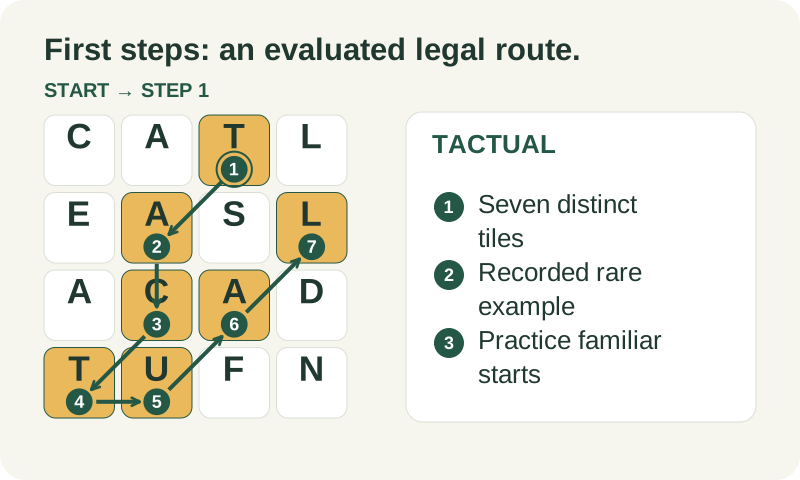
The recorded legal example on this beginner word hunt board is TACTUAL. Its row/column route is r1 c3 → r2 c2 → r3 c2 → r4 c1 → r4 c2 → r3 c3 → r2 c4. Every position was checked for range, adjacency, distinctness, spelling, and ENABLE membership by the independent validator. The rare example is included to make the evaluated route inspectable, not as a vocabulary target for a beginner. Start with familiar short neighbors and use the low-density label as context rather than a required score. You can select a result in the live tool to compare numbered steps; dictionary validity remains separate from another game’s acceptance.
What to carry into your next attempt
Treat this beginner word hunt board as a controlled lesson supported by traceable paths. Difficulty comes from the documented site-specific evaluation, not a verified human rank or another game’s official mode. Keep version and completion context when reviewing results, and choose one decision to repeat before moving to an unfamiliar board.
Check the selected rules and custom points, word-list source and license, verification methods, and local data and network details when interpreting this example.