Curated library · 5 × 5
Stone and turns
STONE across the second row gives an anchor. Expand beyond straight rows and follow diagonal neighbors. This board’s training focus is turning paths. Its fixed letter layout uses generator version v1; change rules to see how the available words change.
Evaluated density: Dense
Default site rules, ENABLE 1 v1: 246 unique words; 36 words with six or more letters; 58,100 total available site points. Full search completed. Evaluated October 10, 2026.
Editorial selection: fixed board layout, legal anchor paths, and the focus described above. Gentle means fewer than 100 available words; otherwise Balanced means fewer than 25 long words, and Dense means at least 25 long words. Density does not prove a board is easier or harder for an individual.
Evaluate this selected board
Custom rules · 5×53+ letters8 directionsQ = Q
Each tile is used once per word. Site word list and scoring are independent of GamePigeon.
Word list & rule versions
Word list: enable1 v1. Rules: custom-5 1.0.0. Scoring: length-v1. GamePigeon word acceptance and scoring are not verified.
Pausing marks the session as paused. Its score stays separate from uninterrupted timed records.
Prepare a board before starting. No answers are shown during practice.
Try a fresh board for this theme · All library boards
Practical details and worked examples
This 5x5 word hunt practice board uses a visible STONE anchor across the second row and encourages you to search beyond straight lines. The extra ring creates additional exits around the anchor, while the fixed letters make turning routes easier to revisit. Confirm that you chose five rows before starting. This is an editorial Custom exercise, not a claim that the size or its score represents an official mode in another game.
Find the anchor in the correct row
Read row 2 from left to right and locate STONE. Its placement helps verify orientation and gives you a starting route you can trace. Do not mistake the first row for the anchor when copying or comparing the board. A shifted row is a different geometric puzzle, even if all the same letters appear somewhere. Once the orientation is correct, investigate neighbors above and below the anchor rather than repeatedly following it unchanged.
Look for a bend at the end of a prefix
On a 5x5 word hunt practice board, a promising beginning need not continue in its initial direction. Check all permitted neighbors at the current endpoint and keep track of positions already used. Right then down is a direction change; moving down-right twice remains a straight diagonal. The distinction becomes important in a turning theme, which evaluates the exact route submitted. A familiar spelling alone does not tell you whether you practiced the intended movement.
Compare alternative routes carefully
The same word can have more than one legal path, and a result may retain several alternatives. Notice where the routes diverge and which leaves a needed tile available for an extension. The displayed alternatives are bounded for usability, not an exhaustive list. If you rebuild a route, check it from the first step rather than swapping its ending into a different start. Distinct positions and adjacency must hold for the whole candidate.
Review the bend you overlooked
Choose a missed word whose useful lesson is a direction change near a prefix you recognized. Follow it slowly with numbered playback, then retry the same board without the route displayed. Keep your Q meaning and adjacency mode unchanged so the movement lesson remains controlled. On the next random five-row challenge, look for a similar bend around a familiar start rather than trying to reproduce the memorized spelling.
Read this board’s recorded evaluation
This board was evaluated on October 10, 2026 using ENABLE 1 v1 and Custom rules 1.0.0: eight directions, no tile reuse, literal Q, and a three-letter minimum. The completed search found 246 distinct words, including 36 with at least six letters. Its Dense label follows the site’s density thresholds. These counts describe opportunities, not a tested human success rate, official-game total, or expected result in one timed attempt.
A practical sequence
- Confirm the fixed letters and size.
- Choose explicit Custom rules and timing.
- Try the selected lesson before viewing answers.
- Inspect one missed route.
- Replay unchanged, then try a fresh board.
A worked example
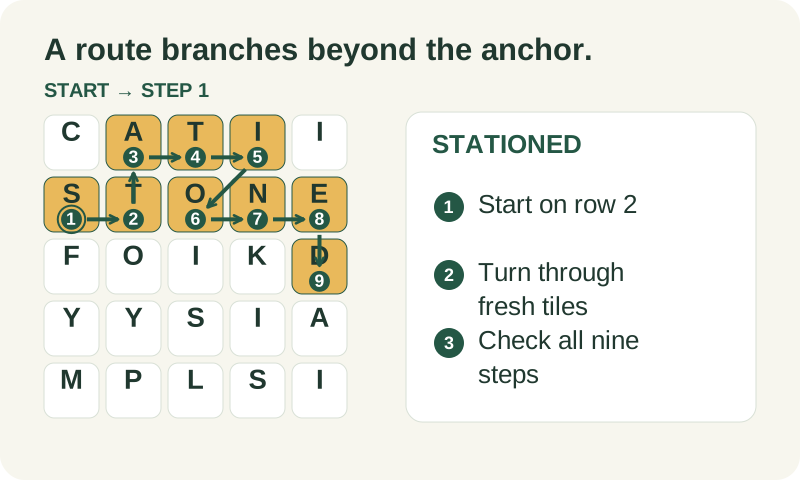
The recorded legal example on this 5x5 word hunt practice board is STATIONED. Its row/column route is r2 c1 → r2 c2 → r1 c2 → r1 c3 → r1 c4 → r2 c3 → r2 c4 → r2 c5 → r3 c5. Every position was checked for range, adjacency, distinctness, spelling, and ENABLE membership by the independent validator. Notice how the route leaves the second-row anchor, uses distinct cells, and turns before reaching its final letter. It is a concrete branching example, not a statement that every alternative route has been retained. You can select a result in the live tool to compare numbered steps; dictionary validity remains separate from another game’s acceptance.
What to carry into your next attempt
Use this fixed challenge to practice one observable decision. Keep dictionary and rule versions, completion status, and pause conditions with comparisons; its evaluation is independent of game acceptance.
Check the selected rules and custom points, word-list source and license, verification methods, and local data and network details when interpreting this example.