Field guide
Word Hunt dictionary: why a game rejects a solver word
Check the letters and path before comparing dictionary and game versions.
Separate three questions
Does the letter sequence exist in our dictionary? Is there a legal path under your selected rules? Does your particular game version accept that word? The solver answers the first two. A different game’s dictionary can reject a valid English word or accept a word this list lacks.
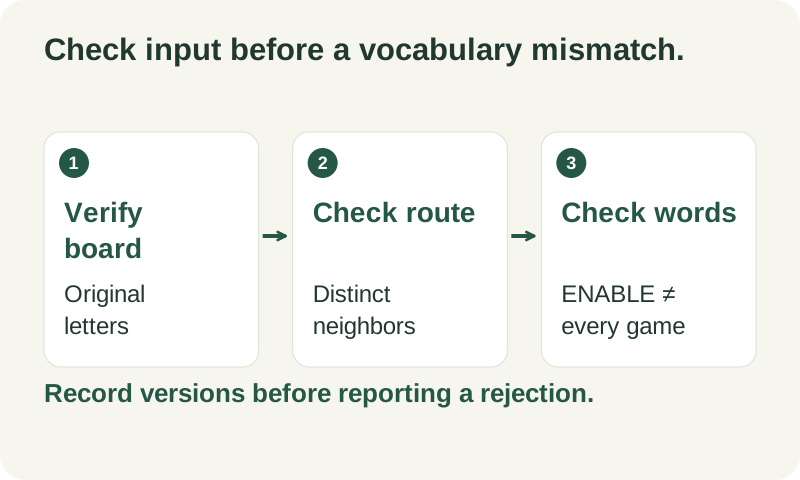
Check in this order
- Compare each screenshot tile with the editable board, especially O/Q, I/J, C/G, E/F, and U/V.
- Play the numbered path and confirm adjacency and no tile reuse.
- Check minimum length and literal Q versus Qu.
- Record the site’s dictionary version and your game’s version before comparing acceptance.
What this site’s list includes
ENABLE is a broad English game-word list. It contains inflections and uncommon or dated vocabulary; it is not a frequency-ranked teaching list and is not an official GamePigeon dictionary. The dictionary specification records the exact source, license, version, normalization, and resource fingerprint.
Report a difference without sending a conversation
Use the feedback draft to provide the word, dictionary version, rule summary, and game version. Review the text before opening the issue composer. The form does not attach a screenshot or local history. A report is a lead to investigate, not proof of universal acceptance or rejection.
Practical details and worked examples
A Word Hunt dictionary determines whether a correctly assembled string is accepted by this solver. It does not repair a board or prove that another game will accept the same entry. If an answer is rejected elsewhere, work through the letters, route, and selected resource before calling it a compatibility problem. This guide explains a practical investigation rather than claiming an official game vocabulary.
Compare every letter with the original board
Start with the submitted board, especially if it came from a screenshot. Check confusing pairs such as O and Q, I and L, and any tile with more than one letter. Confirm row boundaries and the grid size. A single correction can change many Word Hunt answers because every route touching that cell changes. Re-solve after editing and use the new result; an earlier list belongs to the earlier board revision.
Check the route before checking the word list
Select the result and trace its numbered steps. Each cell must be in range, touch the previous cell under the chosen rules, and appear only once. Read the full token on each tile, including explicit QU. A Word Hunt dictionary result still needs the independent path checker, which examines these conditions separately from the search. If the path is legal here but not in another game, compare the movement settings before assuming that the two products disagree about vocabulary.
Identify the resource that made the decision
The current Word Hunt dictionary is ENABLE 1, site version v1, with 172,823 distinct lowercase ASCII entries in its source file. Runtime lookup normalizes letter case. The list includes inflected forms and uncommon terms; it is not a promise of familiar everyday vocabulary. The dictionary page records authorship, public-domain dedication evidence, and a pinned source fingerprint so a reported result can be tied to an exact resource.
Record a game rejection as a bounded observation
For a Word Hunt dictionary comparison with an external game, note the game version, word spelling, board size, tile behavior, and a manually checked legal route. Repeat the attempt if a swipe may have skipped a cell. Avoid sharing the whole conversation screenshot merely to report one entry. One rejected word is evidence about that word in that tested configuration. It does not establish the acceptance rate of every entry or justify a claim of complete incompatibility.
Use the discrepancy to choose a next action
If the original image was wrong, correct it. If the movement rules differ, select matching custom settings when available. If the word is in this list but the game rejects it, treat those Word Hunt answers as site-dictionary suggestions and report the difference with its version. The compatibility benchmark explains how a future authorized sample can separate actual acceptance observations from solver correctness. Vocabulary disagreements should remain visible, not hidden by silently changing letters.
A practical sequence
- Verify the original grid and every tile token.
- Replay the numbered path under the selected adjacency and Q setting.
- Record ENABLE and rule versions with the exact spelling.
- If another game rejects it, document the game version and a repeatable attempt.
A worked example
Imagine a screenshot produced an O where the original tile was Q. A solver word using that position may have a legal path on the entered board, yet it is irrelevant to the real board. Fix the letter and calculate again before reporting a rejection. In a separate case, a correctly entered, legally traced word may appear in ENABLE and still be rejected by a game. Those two situations require different evidence and should not be merged into one compatibility percentage.
What to carry into your next attempt
Use the Word Hunt dictionary as a named, inspectable resource, then keep external acceptance observations separate. A helpful discrepancy report explains the spelling, route, and versions that produced the difference. This makes correction possible without presenting a third-party list as official or changing a board to manufacture plausible results. Keep the Word Hunt dictionary version with that comparison.
Check the selected rules and custom points, word-list source and license, verification methods, and local data and network details when interpreting this example.
Updated October 10, 2026 · Independent Word Hunt Solver project