Field guide
Read and follow Word Hunt swipe paths
Use starts, step numbers, directions, and alternative paths without relying on color.
Find the start before following the line
A result names the word and marks its first tile. Step numbers make repeated letters distinguishable. Direction lines show movement and turning; color is supplementary. The coordinate list is useful when the diagram is crowded or you are using a screen reader.
Replay slowly, then change paths
Select a result to show its path, use the step playback to advance one tile at a time, and pause at a turn. If the solver found multiple routes for the same word, switch routes rather than counting it as another word. Path storage is capped; the alternatives shown need not be every possible route.
A repeated letter needs a different tile
For a word with two As, find two distinct A tiles. Returning to the same A is illegal in the default profile. Likewise, QU contributes two letters but uses only one tile. Read the exact displayed tile token before expecting the step number to match the letter position.
Keep the word and board together
On a phone, use the selected-word path panel to see both at once. For 7×7, enlarge the board rather than trying to hit tiny letters. You can copy words or export the path data; the site does not control a game or swipe on your behalf. Practice turns in turning-path drills.
Practical details and worked examples
Word Hunt swipe paths explain where a word starts and how its letters connect. Read the numbered cells and arrows together: the first number marks the start, each next number identifies the next tile, and the direction line shows the move. The display uses more than color so a route remains understandable on a small screen, in grayscale, or with limited color perception.
Locate the start before following the line
When reading Word Hunt swipe paths, find step 1 and read its row and column. Starting on another occurrence of the same letter may make the rest of the route impossible. Check that the selected word remains visible with the board, especially on a phone. A useful first action is to identify the start and first two neighbors without moving quickly. Speed becomes easier when you already know which repeated letter the route uses.
Describe each movement in plain coordinates
In Word Hunt swipe paths, every next tile must touch the current one under the selected rules. Say right, down-left, or up instead of relying on the line's color. Diagonal movement is allowed by the default eight-direction profile, while the orthogonal option removes it. A turn is simply a change in direction between legal moves. The line may bend several times; the independent checker still checks each pair of neighboring cells separately.
Use alternate routes deliberately
Some words have more than one legal route because letters repeat. The solver retains a bounded set of alternatives, not a promise to enumerate every possible path. Switch alternatives and compare the start and turns. An easier route may be useful practice, but it does not change the word's point value. This small choice is part of Word Hunt strategy: choose a route you can reproduce accurately without returning to a used cell. If a displayed direction line crosses another segment, follow the selected word's step numbers rather than jumping to the crossing line.
Play one step at a time when learning
Use playback to watch the sequence, pause at a turn, then replay it from the beginning. For a longer word, read the complete token on each selected tile; QU can supply two letters at one numbered position. Word Hunt swipe paths describe board movement, so the number of steps can differ from spelling length. Playback is an explanation inside this tool; it does not swipe another application automatically.
Transfer the movement skill to practice
After understanding a route, start a round on that board without keeping the answer list open. Rebuild the word from its letters and check your submission feedback. Repeated-word feedback means it was already submitted; illegal movement means the route itself needs attention. Keep those problems separate. A focused Word Hunt strategy exercise can compare two alternate routes for one missed word before adding more vocabulary or trying a faster timer.
A practical sequence
- Read the selected word and locate step 1.
- Follow every numbered neighboring tile, including full multi-letter tokens.
- Pause or replay at a turn, and compare another retained route if available.
- Try the word in practice without reusing a cell or consulting the answer list.
A worked example
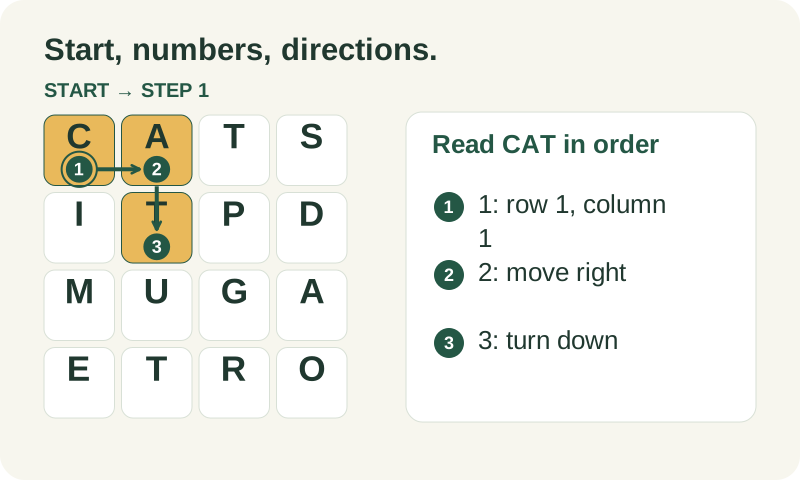
CAT begins at C in row 1 column 1, moves right to A in row 1 column 2, then turns down to T in row 2 column 2. The route uses three distinct cells. Starting at a different C elsewhere does not preserve those coordinates. If a second legal CAT route exists, its own start and numbers define a separate option. Trace each complete route independently; combining the first half of one with the second half of another may create a gap or reuse a tile.
What to carry into your next attempt
Use Word Hunt swipe paths to make each answer reproducible, not merely visible. The most useful checks are the start, the touching moves, and the distinct cells. On a large grid, enlarge the board before tracing. Once a route is clear, practice rebuilding it from memory and review any movement error before increasing speed.
Check the selected rules and custom points, word-list source and license, verification methods, and local data and network details when interpreting this example.
Updated October 10, 2026 · Independent Word Hunt Solver project