Field guide
Word Hunt vs. Word Search vs. Anagrams
Choose a tool based on the game's movement rules and input format.
Match the movement rule to the puzzle
| Game | Input | Typical movement |
|---|---|---|
| Word Hunt | A square tile board | Adjacent tiles; turns allowed; no tile reuse |
| Word Search | A larger letter grid and often a target list | Straight lines; usually no turns |
| Anagrams | A rack or collection of letters | Rearrange letters without board adjacency |
Why the wrong tool misses the task
A free letter rearranger can list words whose letters never connect on your board. A straight-line search can miss CAT when its path turns. Conversely, this solver does not interpret a long word-search grid or enforce a target-word list. Its four supported square sizes do not make it a general word-search engine.
Choose the correct input
For Word Hunt, paste all tiles in row order or use a cropped board screenshot. For rack anagrams, use a dedicated rack tool. For word searches, use a straight-line grid tool. We do not create duplicate pages for those different games or label their answer sets as Word Hunt results.
Brand names do not determine compatibility
Many games use similar grids but different minimum lengths, dictionaries, timers, or special tiles. Read your selected rule profile and the dictionary specification. The broad label “word game” is not enough to establish acceptance in a particular app.
Practical details and worked examples
The key difference in the comparison between these games is movement. A connected tile game lets you turn from one touching cell to another; a typical word-search puzzle asks for letters along a straight line. An anagram puzzle instead rearranges an available set of letters without board adjacency. Identify that contract before choosing an input format, copying answers, or borrowing a solving technique.
Identify whether the route can turn
To compare Word Hunt vs Word Search, first ask whether your board permits a move right and then down while spelling one word. If so, it belongs to the connected-path task supported here. The default profile also allows diagonals and prohibits using the same cell twice. When someone asks what is Word Hunt, that route behavior is the practical starting point. The brand or appearance of square tiles is less informative than the actual rule for moving between them.
Read straight-line puzzles on their own terms
In a typical word search, letters run horizontally, vertically, or diagonally along one line, sometimes backward. A bend that is legal here may be invalid there. A supplied target list can also define the objective rather than a whole dictionary. Word Hunt vs Word Search therefore changes both movement and the task you are trying to finish. This site does not implement a separate straight-line word-search mode simply because both games display grids. Check the puzzle's instructions when a special variant allows bends.
Count anagram letters without importing adjacency
The Word Hunt vs Word Search comparison leaves anagrams as a separate task: an anagram puzzle usually gives letter quantities and asks you to rearrange them. Two occurrences of A can support two As, while one occurrence may not, depending on the game's explicit rules. In a board game, those same letters also need distinct connected positions. A valid anagram can be impossible to trace here. Conversely, a QU tile can contribute two letters from one position, which needs its own interpretation in any quantity-based puzzle.
Match the tool to the actual challenge
Choose this solver when you have a square 4×4 through 7×7 board and a connected-path objective. Enter full rows or inspect a cropped screenshot, then choose the site's custom movement settings. If your task supplies only loose letters or requires straight lines, use a tool designed for that contract. Changing the minimum length does not turn this engine into an anagram generator or a traditional word-search solver.
Transfer vocabulary without transferring every rule
Knowing common prefixes and endings can help in all three formats, but the candidate still needs the correct legal construction. Before discussing Word Hunt vs Word Search answers, ask whether the candidate uses a bend, jumps a gap, or repeats a board cell. Vocabulary knowledge suggests a word; movement verifies it. A practice round on this site measures its own board and dictionary, not proficiency or acceptance in every letter game.
A practical sequence
- Ask whether one word can bend between touching cells.
- Check whether distinct positions or only letter quantities matter.
- Identify any target-word list and the actual board dimensions.
- Use the matching tool and verify its rules before applying an answer.
A worked example
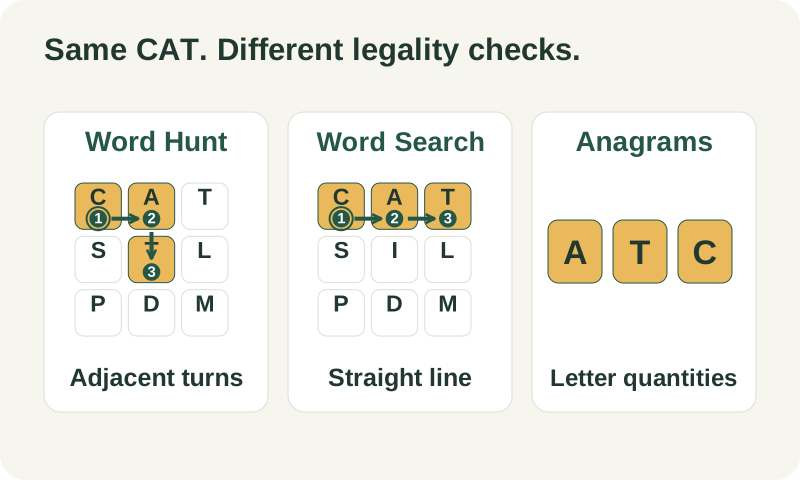
C at row 1 column 1, A at row 1 column 2, and T at row 2 column 2 make CAT through a rightward move and a downward turn. That is a legal connected route under this site's default rules. It is not a straight-line CAT in a typical word search. If C, A, and T are loose anagram letters, their arrangement can produce CAT without those coordinates. The spelling is identical, but the evidence for legality is different in each task.
What to carry into your next attempt
If you are still wondering what is Word Hunt, start by tracing a three-letter route with a turn and no repeated cell. That short example makes the supported task concrete. Then match the grid, movement, and dictionary to your challenge; shared letters and similar-looking tiles do not establish shared acceptance rules.
Check the selected rules and custom points, word-list source and license, verification methods, and local data and network details when interpreting this example.
Updated October 10, 2026 · Independent Word Hunt Solver project