Same date. Same board.
Daily Word Hunt
The challenge date follows America/New_York, rather than your browser’s local date. Select 4×4, 5×5, 6×6, or 7×7; every size has its own deterministic daily board. Refresh and midnight changes preserve this rule, including daylight saving time transitions.
Today’s challenge
Daily board: 2026-10-10 · America/New_York. Updates at New York midnight.
Custom rules · 4×43+ letters8 directionsQ = Q
Each tile is used once per word. Site word list and scoring are independent of GamePigeon.
Word list & rule versions
Word list: enable1 v1. Rules: custom-4 1.0.0. Scoring: length-v1. GamePigeon word acceptance and scoring are not verified.
Pausing marks the session as paused. Its score stays separate from uninterrupted timed records.
Prepare a board before starting. No answers are shown during practice.
Daily generator v1 uses the New York calendar date and board size as its seed. The solver evaluates the selected rule profile before play. Counts and review always refer to the named dictionary version; this is an independent site challenge, not an official daily game.
Practical details and worked examples
Daily word hunt practice gives you a stable challenge keyed to the calendar date in America/New_York. The same date and board size reproduce the same generated letters, so a retry has an understandable reference. Choose your rules separately: a shared board does not make two sessions comparable when one allows diagonals and the other does not. Use the daily puzzle as a small repeatable learning session, with or without the optional timer.
Understand which date defines the board
Daily word hunt practice uses the New York calendar, not your device’s local midnight or a fixed UTC offset. That distinction matters when you live in another time zone or play late in the evening. Daylight saving changes the offset during the year, while the named time zone continues to define the correct local date. Check the displayed date before comparing a board with someone elsewhere. Matching the date alone is not enough; the size must match too.
Handle a date boundary deliberately
A board change is meaningful, so the interface identifies when the daily date has advanced and offers the new challenge. Finish or review the session you already started rather than silently reinterpreting its letters as tomorrow’s puzzle. Saved records retain their actual board. If two screenshots appear different around midnight, compare displayed dates and dimensions first. A calendar transition is not evidence that one person entered letters incorrectly or that the seed has changed unexpectedly.
Make the second attempt informative
Try the challenge once before opening its review. Pick a small missed pattern and replay the same letters under the same settings. The replay tests recognition of that pattern, not general skill against the whole population. A learned board naturally becomes easier with repetition; call that improvement what it is. To test transfer, take the same tactic into a new random board after the retry, while retaining the same minimum length and adjacency.
Read word and path feedback separately
A submission must connect adjacent positions without reuse, assemble enough letters, and belong to the current ENABLE list. Repeating an already found word is reported as a duplicate even when another route exists. A familiar spelling can fail because the path jumps or the game you have in mind uses a different dictionary. The tool reports its own selected rules. Investigate the specific reason before drawing conclusions about your vocabulary.
Keep the result’s context in review
The review pairs found words with missed opportunities and selectable paths. If its search stopped at a budget, the missed set is incomplete. Preserve that status when interpreting the session. Local records also retain rule and dictionary versions, timing mode, and pause information. Compare matching conditions, and use a focused same-board replay to make one lesson concrete. Personal history is optional and remains a learning record rather than a public ranking.
A practical sequence
- Choose the correct size before generating or entering the challenge.
- Confirm adjacency, minimum length, Q behavior, and timer mode.
- Submit adjacent paths and read the reason for each rejection.
- Finish the round and inspect one useful missed route.
- Retry the exact board, then test the skill on a fresh challenge.
A worked example
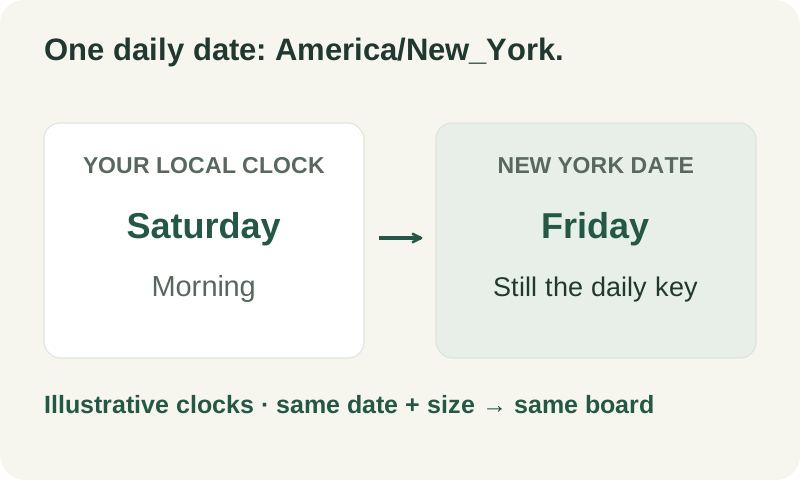
Suppose it is already Saturday morning where you live but still Friday evening in New York. The daily board continues to use Friday’s New York date. A friend using the same date and size can see the same generated letters even though their local clock differs. If you select literal Q and your friend selects automatic QU, accepted words may diverge. Daily word hunt practice shares geometry and letters; it does not secretly force identical rules.
What to carry into your next attempt
Use the displayed date, size, and rule version as the reference for daily word hunt practice. A completed personal round is neither a verified record nor a public ranking. Keep paused attempts marked, choose one missed skill to retry, and let the next New York date provide a fresh challenge without rewriting the meaning of yesterday’s session.
Check the selected rules and custom points, word-list source and license, verification methods, and local data and network details when interpreting this example.