Focused practice
Board scanning
Work through every starting position in rows. A visible start-tile checklist helps you keep track without suggesting answers. Check every starting tile and find legal words. A legal word outside the target receives clear feedback; keep searching for the selected skill.
Set up your practice
Check every starting tile and find legal words.
Custom rules · 4×43+ letters8 directionsQ = Q
Each tile is used once per word. Site word list and scoring are independent of GamePigeon.
Word list & rule versions
Word list: enable1 v1. Rules: custom-4 1.0.0. Scoring: length-v1. GamePigeon word acceptance and scoring are not verified.
Pausing marks the session as paused. Its score stays separate from uninterrupted timed records.
Prepare a board before starting. No answers are shown during practice.
Review the skill after the round
Check found and missed words, filter the review by this theme, and select words for a focused same-board retry. Turning-path drills evaluate the exact path you submitted; finding a word by a straight path does not complete that target. Board scanning provides a start-tile checklist that you control.
Practical details and worked examples
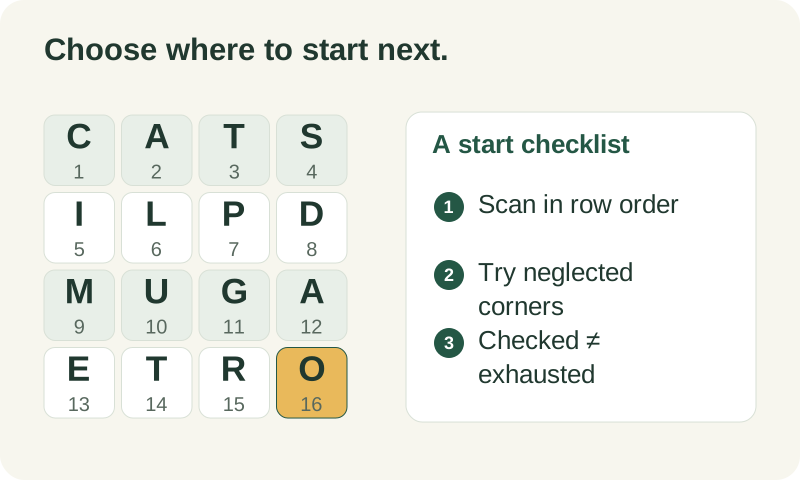
Systematic scanning reduces the chance that you repeatedly search a familiar region and never start elsewhere. Word hunt board scanning provides a start-tile checklist that you control. A checked tile means you deliberately inspected it; it does not certify that you exhausted every possible dictionary prefix there. Choose an order that is easy to remember, keep the rules stable, and use review to locate the positions your routine overlooked.
Choose an order before chasing answers
In word hunt board scanning, a row-by-row sequence is simple: inspect each starting position in the top row, then move down. You can also begin with corners and edges before entering the center, provided the sequence remains deliberate. The order organizes attention rather than restricting legal movement. A word starting in the first row can travel into later rows through adjacent cells. Do not confuse your scanning regions with walls that are absent from the game rules.
Use the checklist as an attention record
Mark a start when you have actually examined its nearby possibilities. Do not mark it just because one accepted word passes through that tile from a different start. The distinction matters: finding a word that ends in a corner does not mean you considered what could begin there. The checklist is manual and contains no hidden answer suggestion. It helps you notice unfinished attention rather than telling you the board has been completely searched.
Balance branching with limited time
Corners have fewer neighboring exits than centers, so they can be quicker to inspect. Center positions create more branches and can absorb a disproportionate part of a timed round. Use a manageable prefix goal for a dense position, then continue your planned sequence instead of getting trapped there. In an untimed lesson, revisit it afterward. A deliberate stop is different from proving that no further word can start at that location.
Review where missed routes begin
At the end, select missed words and note their starting positions. A concentration in one edge or row suggests a coverage gap, while many misses at already checked starts may indicate shallow branching or recall. Choose the appropriate lesson rather than simply checking boxes faster next time. A useful word hunt strategy combines broad coverage with selected depth, and a same-board retry helps show which part of that balance changed.
Carry the lesson into an ordinary round
Finish with one manageable takeaway rather than a list you cannot retain. Replay the exact letters and conditions to recognize the missed pattern, then try a fresh challenge on the same size. Keep timing and pause status visible when comparing attempts. A drill target is a teaching constraint: words outside that target can still be legal. Review membership, path feedback, and completion status before deciding what the round tells you.
A practical sequence
- Choose a comfortable grid and the selected skill theme.
- Read the target and keep the rule profile unchanged.
- Begin untimed when route precision is the main obstacle.
- Submit one full path and distinguish target feedback from invalidity.
- Review a missed example, retry it, and test transfer on another board.
A worked example
Suppose you repeatedly find words near the top-left C but never start from the lower-right corner. A row-major checklist makes that omission visible before the timer ends. After review, choose a missed word beginning in that corner and inspect its first two neighbors. Word hunt board scanning is not a guarantee of exhaustive human search; it is a way to make neglected positions observable and turn them into a specific practice goal.
What to carry into your next attempt
Use word hunt board scanning as a focused exercise, not a promise of an official-game score or a universal improvement rate. The same board and rules let you inspect one changed decision. A fresh board then tests whether that decision has become a transferable habit. Keep dictionary and search-completion limits in view when interpreting missed opportunities.
Check the selected rules and custom points, word-list source and license, verification methods, and local data and network details when interpreting this example.