Focused practice
Long words
Extend legal prefixes a tile at a time. Longer words are useful only when every step stays adjacent. Find words with at least 6 letters. A legal word outside the target receives clear feedback; keep searching for the selected skill.
Set up your practice
Find words with at least 6 letters.
Custom rules · 4×43+ letters8 directionsQ = Q
Each tile is used once per word. Site word list and scoring are independent of GamePigeon.
Word list & rule versions
Word list: enable1 v1. Rules: custom-4 1.0.0. Scoring: length-v1. GamePigeon word acceptance and scoring are not verified.
Pausing marks the session as paused. Its score stays separate from uninterrupted timed records.
Prepare a board before starting. No answers are shown during practice.
Review the skill after the round
Check found and missed words, filter the review by this theme, and select words for a focused same-board retry. Turning-path drills evaluate the exact path you submitted; finding a word by a straight path does not complete that target. Board scanning provides a start-tile checklist that you control.
Practical details and worked examples
Long targets reward connected prefixes, careful branching, and a complete legal route. This theme asks for at least six letters, but length alone does not make an answer useful or accepted. You still need the selected dictionary, proper adjacency, and no tile reuse. Work without a timer while learning the search pattern, then add pressure when you can explain how you extended a prefix without losing track of earlier positions.
Count letters rather than drawn steps
In long word hunt practice, the six-letter threshold refers to the spelling assembled from tile tokens. A QU token supplies two letters while occupying one grid position. That distinction matters when comparing paths or estimating how much room an extension needs. A five-letter word remains outside the target even if its route is visually elaborate. Conversely, a qualifying word can use fewer than six positions when a multi-letter tile contributes part of its spelling.
Keep a prefix and examine its next options
In long word hunt practice, start from a plausible beginning and consider adjacent letters that can continue it. Do not commit to a familiar ending before you see a connected route. At a branching point, inspect another neighbor when the first continuation fails. The solver uses dictionary-prefix pruning internally; your practice counterpart is remembering enough of a likely word family to direct attention without pretending that every imaginable extension is a real accepted word.
Track which positions are already occupied
Long routes increase the chance that an attractive final letter is one you used earlier. Repeated letters are allowed only when they come from different positions. Slow down at turns and look at the route’s numbered steps when reviewing. If the same spelling has alternate paths, compare where they diverge and whether one leaves a useful tile free for the continuation. Do not swap routes midway without checking the full rebuilt path.
Learn one extension you can recognize again
Choose a missed long word whose prefix or ending is useful beyond that exact puzzle. Trace it slowly, identify the branch you overlooked, then retry under unchanged conditions. Rare entries may be legitimate members of ENABLE without being worthwhile first lessons. A practical word hunt strategy favors patterns that transfer: noticing a connected suffix, protecting a needed vowel, or looking around a turn rather than assuming a row must stay straight.
Carry the lesson into an ordinary round
Finish with one manageable takeaway rather than a list you cannot retain. Replay the exact letters and conditions to recognize the missed pattern, then try a fresh challenge on the same size. Keep timing and pause status visible when comparing attempts. A drill target is a teaching constraint: words outside that target can still be legal. Review membership, path feedback, and completion status before deciding what the round tells you.
A practical sequence
- Choose a comfortable grid and the selected skill theme.
- Read the target and keep the rule profile unchanged.
- Begin untimed when route precision is the main obstacle.
- Submit one full path and distinguish target feedback from invalidity.
- Review a missed example, retry it, and test transfer on another board.
A worked example
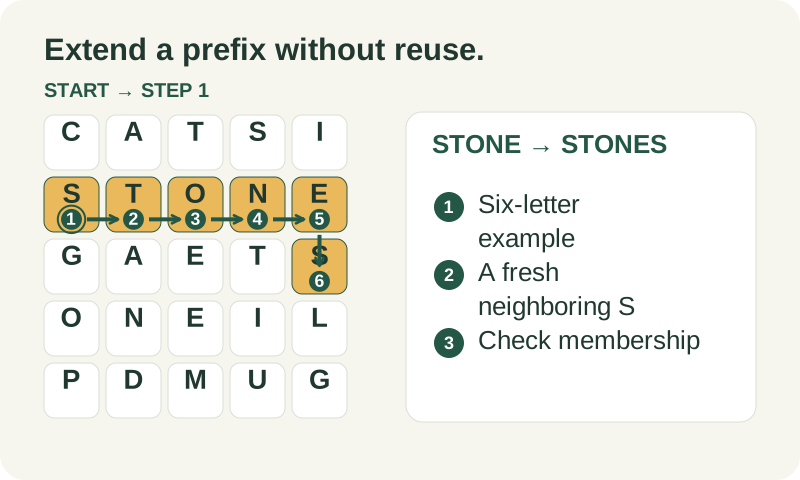
Imagine you have a legal STONE route and see letters that might continue into a longer word. The family connection is only a prompt to inspect geometry. Every added letter must be adjacent to the current end and occupy a fresh position. A distant ending cannot be borrowed. Long word hunt practice teaches you to connect a known prefix to an actual legal continuation, then confirm the complete spelling rather than reward a familiar idea alone.
What to carry into your next attempt
Use long word hunt practice as a focused exercise, not a promise of an official-game score or a universal improvement rate. The same board and rules let you inspect one changed decision. A fresh board then tests whether that decision has become a transferable habit. Keep dictionary and search-completion limits in view when interpreting missed opportunities.
Check the selected rules and custom points, word-list source and license, verification methods, and local data and network details when interpreting this example.