Focused practice
Prefixes & suffixes
Look for word families and endings such as S, ED, ER, and ING. Rebuild each word as an independent path. Find words with common starts or endings. A legal word outside the target receives clear feedback; keep searching for the selected skill.
Set up your practice
Find words with common starts or endings.
Custom rules · 4×43+ letters8 directionsQ = Q
Each tile is used once per word. Site word list and scoring are independent of GamePigeon.
Word list & rule versions
Word list: enable1 v1. Rules: custom-4 1.0.0. Scoring: length-v1. GamePigeon word acceptance and scoring are not verified.
Pausing marks the session as paused. Its score stays separate from uninterrupted timed records.
Prepare a board before starting. No answers are shown during practice.
Review the skill after the round
Check found and missed words, filter the review by this theme, and select words for a focused same-board retry. Turning-path drills evaluate the exact path you submitted; finding a word by a straight path does not complete that target. Board scanning provides a start-tile checklist that you control.
Practical details and worked examples
Word Hunt prefixes and suffixes are useful search prompts, especially after you discover a base word. They are not permission to add letters from anywhere on the board. This family-focused theme asks you to recognize likely patterns and rebuild each candidate as an independent route. The actual filter includes starts such as RE, UN, IN, and PRE, and endings such as S, ED, ER, ING, and LY; dictionary membership still decides validity.
Look for available starts and endings
Notice connected letter groups before deciding which word they complete. An adjacent E and D might support an ending; RE might support a beginning. Their usefulness depends on which base can connect without overlap or gaps. Keep the selected adjacency rule in mind, because diagonal endings disappear in orthogonal mode. The target is a structural search aid, not a complete linguistic definition of every English prefix or suffix.
Rebuild the whole family member
Finding a base does not mean that its exact route can be extended. A plural or past-tense form may require a different starting position or alternate path to leave its final letter available. Draw each family member from the beginning and check every step. If you reuse the S already inside the base, the candidate fails even when the spelling is common. A correct word family can have an unavailable member on this particular grid.
Let the selected list decide spelling
English morphology has exceptions, irregular forms, and endings that do not attach to every base. Do not assume that a plausible suffix makes a dictionary word. Word hunt practice uses the versioned ENABLE list, while a different game may accept a different set. Read the reason for rejection, verify the visible letters, and distinguish a route error from an absent spelling before changing your learning strategy.
Review the opportunity you failed to notice
After the round, inspect one missed family and compare its base and extended routes. Ask whether you missed the letter group, failed to reconsider a base, or chose a path that consumed a necessary tile. That diagnosis is more useful than counting every word ending in S. Retry the same board to recognize the specific extension, then look for the same pattern in a new challenge with matching rules.
Carry the lesson into an ordinary round
Finish with one manageable takeaway rather than a list you cannot retain. Replay the exact letters and conditions to recognize the missed pattern, then try a fresh challenge on the same size. Keep timing and pause status visible when comparing attempts.
A practical sequence
- Choose a comfortable grid and the selected skill theme.
- Read the target and keep the rule profile unchanged.
- Begin untimed when route precision is the main obstacle.
- Submit one full path and distinguish target feedback from invalidity.
- Review a missed example, retry it, and test transfer on another board.
A worked example
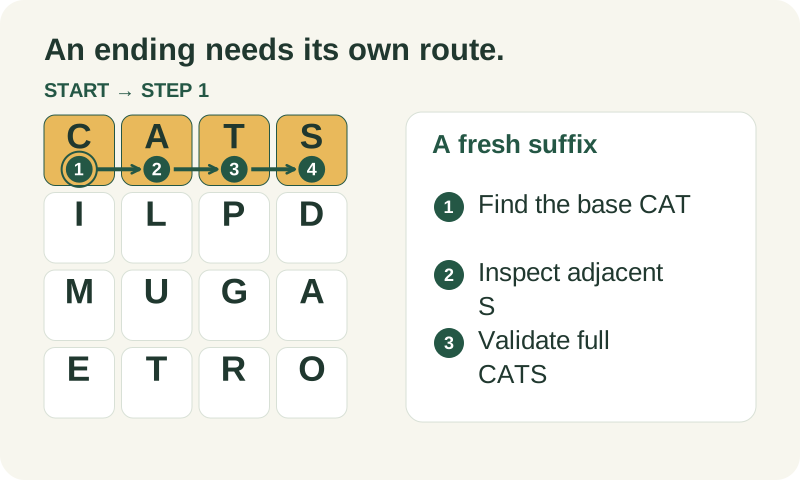
A row C A T S supports CAT and CATS with a fresh final S. If the only S is already used earlier in a different base route, an extension needs another path or another S position. Word hunt prefixes and suffixes training asks you to notice the family relationship and then validate its geometry. Familiar morphology suggests where to look; it never substitutes for the route, distinct positions, minimum length, or membership check.
What to carry into your next attempt
Use word hunt prefixes and suffixes as a focused exercise, not a promise of an official-game score or a universal improvement rate. The same board and rules let you inspect one changed decision. A fresh board then tests whether that decision has become a transferable habit. Keep dictionary and search-completion limits in view when interpreting missed opportunities.
Check the selected rules and custom points, word-list source and license, verification methods, and local data and network details when interpreting this example.