A fresh board, checked before play
Random practice
Fresh weighted-letter boards include a few useful anchors. We evaluate up to six candidates and retain a more useful word count for your chosen rules. Word density is a transparent training aid, not a promise that a board will feel easy.
Set up your practice
Custom rules · 4×43+ letters8 directionsQ = Q
Each tile is used once per word. Site word list and scoring are independent of GamePigeon.
Word list & rule versions
Word list: enable1 v1. Rules: custom-4 1.0.0. Scoring: length-v1. GamePigeon word acceptance and scoring are not verified.
Pausing marks the session as paused. Its score stays separate from uninterrupted timed records.
Prepare a board before starting. No answers are shown during practice.
Practical details and worked examples
Random word hunt practice is for a fresh challenge when you do not need the shared daily date. Treat word hunt unlimited as local variety: generate a board, choose a size, and decide whether you are exploring freely or testing a timed routine. The generator uses weighted letters and intentional starter paths rather than guaranteeing equal difficulty. A new board offers new opportunities, but its score cannot be compared fairly with an unrelated board without considering the available words.
Know how a generated board is made
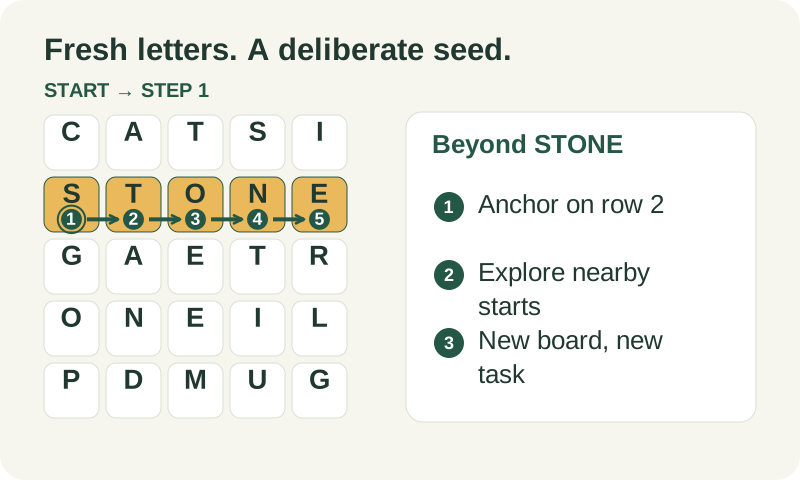
Common letters appear more often than rare ones, and a short CAT path makes generated practice boards playable. At sizes five and above, STONE is also seeded across the second row. These deliberate anchors support an entry point into practice; the generator is not described as a simulation of another game’s proprietary board distribution. Explore beyond the anchors and use solver evaluation when you want to understand how dense the remaining board is.
Explore first, then add pressure
Untimed random word hunt practice lets you examine a prefix carefully and learn why a route works. Once you have a repeatable search order, add the optional timer on a comparable size. Speed can hide uncertainty: a rushed invalid path may look like a vocabulary failure even when you know the word. Read the submission feedback before changing tactics. Separate route precision from recall, then increase pressure only when the path-building behavior is reliable. Finish the untimed round before starting a timed retry so the elapsed record describes one coherent set of conditions.
Avoid treating opportunity as ability
Two generated boards can differ substantially in useful vowels, connected word families, and long-word potential. A higher score on the second board might reflect those opportunities. Instead of declaring a universal improvement, compare found words with the solved opportunities for that board, examine repeated mistakes, and watch one skill across several sessions. Saved history helps retain the context, while a same-board replay isolates learning more directly than an unrelated random total.
Read word and path feedback separately
A random word hunt practice submission must connect adjacent positions without reuse, assemble enough letters, and belong to the current ENABLE list. Repeating an already found word is reported as a duplicate even when another route exists. A familiar spelling can fail because the path jumps or the game you have in mind uses a different dictionary. The tool reports its own selected rules. Investigate the specific reason before drawing conclusions about your vocabulary.
Keep the result’s context in review
The review pairs found words with missed opportunities and selectable paths. If its search stopped at a budget, the missed set is incomplete. Preserve that status when interpreting the session. Local records also retain rule and dictionary versions, timing mode, and pause information. Compare matching conditions, and use a focused same-board replay to make one lesson concrete. Personal history is optional and remains a learning record rather than a public ranking.
A practical sequence
- Choose the correct size before generating or entering the challenge.
- Confirm adjacency, minimum length, Q behavior, and timer mode.
- Submit adjacent paths and read the reason for each rejection.
- Finish the round and inspect one useful missed route.
- Retry the exact board, then test the skill on a fresh challenge.
A worked example
Generate a five-row board and use STONE across the second row to verify your orientation. Then inspect starts just above and below that row instead of repeatedly submitting the anchor. After review, choose one overlooked short neighbor and retry it. On the next board, look for the same structural pattern rather than the same exact word. Word hunt unlimited can mean generating fresh local challenges; it does not mean unlimited search time or equal difficulty.
What to carry into your next attempt
Use random word hunt practice to test transfer after a focused lesson. Keep the selected rules stable, distinguish pauses from uninterrupted timing, and review the board’s actual missed opportunities. Random generation is a convenient source of variety, not a verified ranking system, official distribution, or promise that every challenge has the same number of acceptable words.
Check the selected rules and custom points, word-list source and license, verification methods, and local data and network details when interpreting this example.