Dictionary compatibility
Word Hunt dictionary compatibility: game acceptance
Current release: zero installed GamePigeon versions and zero accepted/rejected game-word samples tested.
Known versus unverified
The site’s ENABLE1 v1 word list and Custom rule profiles are versioned and inspectable. The current GamePigeon dictionary, exact scoring, timer, special letters, and official supported modes have not been tested on an installed app. No percentage compatibility estimate is published.
A reproducible test record
For each consenting game session, record app version, operating system, actual board, rule assumptions, submitted word, legal path, acceptance or rejection, and displayed score change. Keep only the board crop or anonymized record needed for verification; permission to play is not automatically permission to publish someone’s screenshot.
Use a stratified sample
Include common and uncommon words, inflections, minimum-length boundaries, Q/Qu, repeat-letter routes, and longer words. Freeze candidate words before testing. Count accepted and rejected predictions separately. A convenience set of easy accepted words cannot estimate compatibility across the whole dictionary.
Do not invent recall
Without an official exhaustive accepted-word set, a limited submitted sample cannot establish total missed-word recall. Score differences and dictionary differences also need separate reporting. Mark each recorded game version and date; rejection in one version is not universal proof that a word is invalid English.
Help investigate a difference
Check letters and the legal path first, then compare dictionary versions. Prepare a feedback draft with only the fields you intend to share. Reports remain unverified until independently checked.
Practical details and worked examples
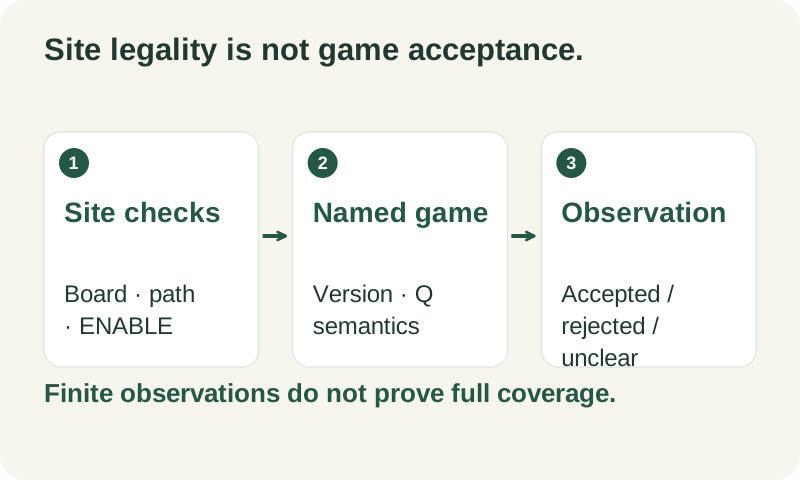
External-game acceptance asks whether another game accepts words under a documented configuration. That differs from checking whether this solver correctly searches ENABLE and returns legal paths. The current release has no authorized current-game acceptance dataset, so it publishes the method and the gap rather than an acceptance percentage. A named game version and a valid route are prerequisites for an interpretable observation.
Establish the solver’s own contract first
The shipped Word Hunt dictionary is ENABLE 1, version v1. This site's path validator checks neighboring distinct cells, complete tile tokens, configured minimum length, and the chosen Q behavior. Matching a small-board reference supports correctness under that contract. It does not certify another application's vocabulary. Keep the site rule and resource versions with a candidate so an acceptance investigation begins from an actual reproducible result rather than a remembered spelling.
Record the external configuration explicitly
For a future authorized test, identify the game name, application version, operating system, board mode, special-letter behavior, and relevant timing or scoring settings. Do not label larger custom boards as official modes without evidence. Confirm how the game treats Q and multi-letter tiles before attributing a rejection to its word list. Word Hunt dictionary compatibility can change with an application update or setting; an undated anecdote cannot establish a current resource match.
Verify the attempted path independently
For Word Hunt dictionary compatibility checks, transcribe the source board and inspect every coordinate before attempting the word. Confirm that the actual swipe followed that route; a missed neighbor or repeated tile can look like a vocabulary rejection. Repeat unclear attempts and record them as unresolved rather than forcing acceptance or rejection. If an image is used as supporting evidence, obtain permission and remove unrelated conversation content. One precise route is better evidence than an entire private screenshot.
Interpret finite samples with their limits visible
A declared sample can report how many tested candidates were accepted, rejected, or unresolved in that configuration. It cannot establish complete vocabulary equivalence, especially if the selected candidates favored common short words. Record the sampling method, word-length distribution, and treatment of duplicates or inflections. The Word Hunt dictionary also contains rare and adult terms; changing which groups are tested changes the question being answered. Preserve that scope with any reported rate.
Use findings without silently rewriting the resource
A verified difference can become a documented observation or inform a future separately versioned compatibility profile. It should not cause the recognizer to alter a letter or the solver to describe ENABLE as official. Maintain the independently licensed source and its fingerprint. Word Hunt dictionary compatibility is an evidence layer around a tested game configuration, while resource membership and path correctness remain their own inspectable layers.
A practical sequence
- Freeze site dictionary and rule versions and select a declared candidate sample.
- Record the external game version and its observed tile semantics.
- Check and repeat each legal route, labeling unclear attempts unresolved.
- Report the sample method and bounded results without claiming complete acceptance coverage.
A worked example
A candidate can appear in ENABLE and have a legal route on a confirmed board, yet fail in another game. Before calling that a vocabulary difference, inspect whether the game interpreted a Q tile as QU and whether the swipe visited the intended cells. If both checks hold after repetition, record that word as rejected in the named configuration. It remains one observation. It does not justify a claim about every inflection, every board size, or every future application version.
What to carry into your next attempt
Treat Word Hunt dictionary compatibility as a versioned empirical question. The present status is unmeasured external acceptance, with a reproducible method ready for authorized observations. Keep membership, path construction, game behavior, and finite-sample interpretation separate so future evidence can improve the tool without overstating what a small test proves.
Check the selected rules and custom points, word-list source and license, verification methods, and local data and network details when interpreting this example.
Updated October 10, 2026 · Independent Word Hunt Solver project