Curated library · 7 × 7
Seven-day stretch
Use the larger connected space to extend common starts. Long words use letters, not necessarily more tiles when QU is active. This board’s training focus is long words. Its fixed letter layout uses generator version v1; change rules to see how the available words change.
Evaluated density: Dense
Default site rules, ENABLE 1 v1: 567 unique words; 154 words with six or more letters; 154,100 total available site points. Full search completed. Evaluated October 10, 2026.
Editorial selection: fixed board layout, legal anchor paths, and the focus described above. Gentle means fewer than 100 available words; otherwise Balanced means fewer than 25 long words, and Dense means at least 25 long words. Density does not prove a board is easier or harder for an individual.
Evaluate this selected board
Custom rules · 7×73+ letters8 directionsQ = Q
Each tile is used once per word. Site word list and scoring are independent of GamePigeon.
Word list & rule versions
Word list: enable1 v1. Rules: custom-7 1.0.0. Scoring: length-v1. GamePigeon word acceptance and scoring are not verified.
Pausing marks the session as paused. Its score stays separate from uninterrupted timed records.
Prepare a board before starting. No answers are shown during practice.
Try a fresh board for this theme · All library boards
Practical details and worked examples
This seven-row challenge gives longer connected prefixes a wide space to develop. Forty-nine positions also make attention and path legibility important. Use zoom before attempting a route you cannot read clearly, and choose a limited goal for the first round. The board is a fixed Custom exercise with a recorded evaluation; its size is not evidence that every player should find more words or finish a complete manual scan under one deadline.
Enlarge the view before enlarging the goal
Choose a display scale that makes letters, starts, and numbered steps legible. The selected word remains the reference while you inspect its route. Zoom changes only the view, not the board’s geometry or legal movement. Do not attempt to infer a tiny final step from color alone. A directional line and number identify whether the route really reaches the intended neighbor, particularly along the far edge of a wide grid.
Use a prefix as an attention anchor
Look for a familiar start, then inspect available continuations rather than assuming a remembered long spelling must exist. Keep track of occupied positions at every bend. A multi-letter token supplies several letters in one tile, so long-word length need not equal path length. Examine whether an alternate route preserves a needed continuation. The goal is a connected accepted word, not an impressive-looking line across distant parts of the board.
Give the scan a manageable boundary
Try one row of starts or one small region before expanding the objective. Paths can leave that region legally; the boundary controls where you begin, not where you may move. A large board can contain many short opportunities as well as long ones. If your first round misses basic neighbors, switch the next lesson to those patterns instead of treating the largest available grid as the right challenge for every skill.
Respect incomplete review sets
The worker has an explicit search budget, and expensive repeated-letter boards can finish with partial results. Check review completion before interpreting unlisted words as impossible or calculating an apparent share of every available word. A useful local lesson still exists in the found paths. Keep timing and pauses visible, replay one missed extension on this board, and use an unfamiliar board afterward to test transfer without implying a verified performance ranking.
Read this board’s recorded evaluation
This 7x7 word hunt practice board was evaluated on October 10, 2026 using ENABLE 1 v1 and Custom rules 1.0.0: eight directions, no tile reuse, literal Q, and a three-letter minimum. The completed search found 567 distinct words, including 154 with at least six letters. Its Dense label follows the site’s density thresholds. These counts describe opportunities, not a tested human success rate, official-game total, or expected result in one timed attempt.
A practical sequence
- Inspect the fixed board and its recorded size and theme.
- Choose a timer mode and explicit Custom rules.
- Try the editorial lesson before opening reference paths.
- Review one missed route and identify the overlooked decision.
- Replay unchanged, then test the habit on a fresh challenge.
A worked example
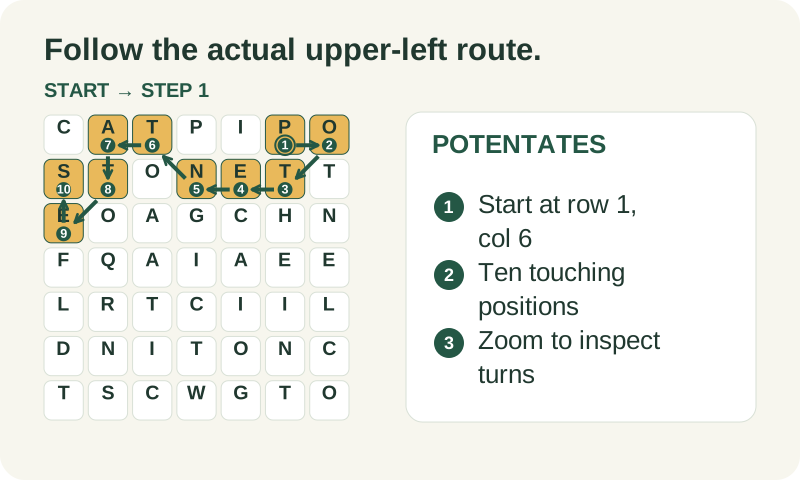
The recorded legal example on this 7x7 word hunt practice board is POTENTATES. Its row/column route is r1 c6 → r1 c7 → r2 c6 → r2 c5 → r2 c4 → r1 c3 → r1 c2 → r2 c2 → r3 c1 → r2 c1. Every position was checked for range, adjacency, distinctness, spelling, and ENABLE membership by the independent validator. This example reaches the top and left regions through connected positions. It makes no assertion that the bottom-right corner belongs to this spelling. Use zoom to follow the actual coordinates instead of extrapolating a route. You can select a result in the live tool to compare numbered steps; dictionary validity remains separate from another game’s acceptance.
What to carry into your next attempt
Treat this 7x7 word hunt practice board as a controlled lesson supported by traceable paths. Difficulty comes from the documented site-specific evaluation, not a verified human rank or another game’s official mode. Keep version and completion context when reviewing results, and choose one decision to repeat before moving to an unfamiliar board.
Check the selected rules and custom points, word-list source and license, verification methods, and local data and network details when interpreting this example.