Curated library · 6 × 6
Six-row scan
A larger board rewards a repeatable start-tile scan. Try one row of starting tiles at a time. This board’s training focus is board scanning. Its fixed letter layout uses generator version v1; change rules to see how the available words change.
Evaluated density: Dense
Default site rules, ENABLE 1 v1: 629 unique words; 181 words with six or more letters; 179,200 total available site points. Full search completed. Evaluated October 10, 2026.
Editorial selection: fixed board layout, legal anchor paths, and the focus described above. Gentle means fewer than 100 available words; otherwise Balanced means fewer than 25 long words, and Dense means at least 25 long words. Density does not prove a board is easier or harder for an individual.
Evaluate this selected board
Custom rules · 6×63+ letters8 directionsQ = Q
Each tile is used once per word. Site word list and scoring are independent of GamePigeon.
Word list & rule versions
Word list: enable1 v1. Rules: custom-6 1.0.0. Scoring: length-v1. GamePigeon word acceptance and scoring are not verified.
Pausing marks the session as paused. Its score stays separate from uninterrupted timed records.
Prepare a board before starting. No answers are shown during practice.
Try a fresh board for this theme · All library boards
Practical details and worked examples
This 6x6 word hunt practice board emphasizes coverage: deliberately beginning from positions across the board rather than staying in one familiar region. Thirty-six cells create more places to neglect, especially when the center offers many attractive branches. The fixed board supports a repeatable scan and an honest same-board retry. Use the recorded evaluation to understand word opportunity, then set a personal objective based on attention rather than a universal target score.
Keep the six-row geometry visible
Confirm six rows of six tiles and identify the row boundaries before play. On a smaller screen, inspect letters and step markers at a comfortable scale instead of relying on an indistinct overview. A word can cross any imagined scanning sector through legal neighbors. Your row divisions are organizational aids, not movement restrictions. If you entered or imported the board, check the last tile of each row to catch a shifted sequence.
Choose a start-position sequence
For this 6x6 word hunt practice board, a simple plan is to inspect starts in rows 1 and 2, then 3 and 4, then 5 and 6. Continue from the current starting position into any permitted adjacent row when a word needs it. Use the checklist deliberately if the scanning theme is enabled. A tile that appears halfway through a found route has not necessarily been examined as a start. That difference helps identify whether your attention has covered the intended region.
Control the branching in the center
Interior tiles have more exits than corners and can absorb time through repeated partial searches. Give a dense start a limited prefix objective, then continue the planned sequence and return later in an untimed lesson. Stopping your inspection is not proof that no additional word exists there. Read the solver’s separate completion status in review, and avoid confusing human coverage with the engine’s exhaustive prefix traversal under its budget.
Locate the starts of your missed words
At review, note whether missed routes concentrate in lower rows, edges, or already checked centers. A neglected row suggests broad coverage needs work; misses at frequently checked starts may point to recall or shallow branching. Choose the next exercise based on that difference. Repeat the exact six-row board to correct one coverage gap, then take the same start order to a fresh challenge with the rule profile unchanged.
Read this board’s recorded evaluation
This board was evaluated on October 10, 2026 using ENABLE 1 v1 and Custom rules 1.0.0: eight directions, no tile reuse, literal Q, and a three-letter minimum. The completed search found 629 distinct words, including 181 with at least six letters. Its Dense label follows the site’s density thresholds. These counts describe opportunities, not a tested human success rate, official-game total, or expected result in one timed attempt.
A practical sequence
- Confirm the fixed letters and size.
- Choose explicit Custom rules and timing.
- Try the selected lesson before viewing answers.
- Inspect one missed route.
- Replay unchanged, then try a fresh board.
A worked example
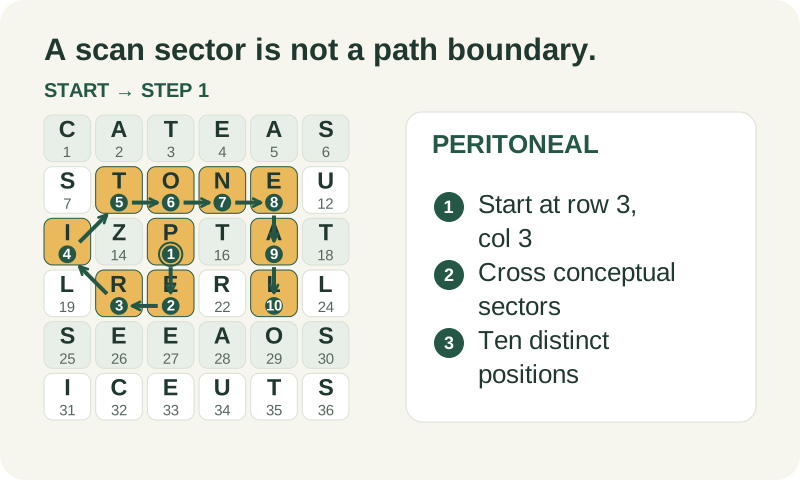
The recorded legal example on this 6x6 word hunt practice board is PERITONEAL. Its row/column route is r3 c3 → r4 c3 → r4 c2 → r3 c1 → r2 c2 → r2 c3 → r2 c4 → r2 c5 → r3 c5 → r4 c5. Every position was checked for range, adjacency, distinctness, spelling, and ENABLE membership by the independent validator. The example begins in row 3 and traverses several regions. Your start-position scan may divide attention into row pairs, but a legal route crosses those conceptual boundaries freely. You can select a result in the live tool to compare numbered steps; dictionary validity remains separate from another game’s acceptance.
What to carry into your next attempt
Use this fixed challenge to practice one observable decision. Keep dictionary and rule versions, completion status, and pause conditions with comparisons; its evaluation is independent of game acceptance.
Check the selected rules and custom points, word-list source and license, verification methods, and local data and network details when interpreting this example.