Curated library · 5 × 5
Word family garden
After finding a base word, check adjacent S, ED, ER, and ING continuations; each extension must have its own legal path. This board’s training focus is prefixes and suffixes. Its fixed letter layout uses generator version v1; change rules to see how the available words change.
Evaluated density: Dense
Default site rules, ENABLE 1 v1: 329 unique words; 60 words with six or more letters; 82,200 total available site points. Full search completed. Evaluated October 10, 2026.
Editorial selection: fixed board layout, legal anchor paths, and the focus described above. Gentle means fewer than 100 available words; otherwise Balanced means fewer than 25 long words, and Dense means at least 25 long words. Density does not prove a board is easier or harder for an individual.
Evaluate this selected board
Custom rules · 5×53+ letters8 directionsQ = Q
Each tile is used once per word. Site word list and scoring are independent of GamePigeon.
Word list & rule versions
Word list: enable1 v1. Rules: custom-5 1.0.0. Scoring: length-v1. GamePigeon word acceptance and scoring are not verified.
Pausing marks the session as paused. Its score stays separate from uninterrupted timed records.
Prepare a board before starting. No answers are shown during practice.
Try a fresh board for this theme · All library boards
Practical details and worked examples
This five-row challenge is selected for noticing related spellings and rebuilding each one legally. Finding a base word is only the first decision. Check whether an adjacent S, ED, ER, or ING continuation exists, whether it uses fresh positions, and whether the complete spelling belongs to the selected list. The family theme directs attention toward possible extensions without promising that every familiar form can be made from this board.
Look for the available letter groups
Inspect connected starts and endings rather than isolated letters scattered across the grid. An E beside a D can suggest a past-tense pattern, but the group matters only when a base route can reach it. Keep the chosen adjacency mode explicit, since a diagonal connection is absent in orthogonal mode. The editorial theme is a learning prompt; ordinary accepted words outside a family pattern remain legitimate opportunities on the challenge.
Use the base as a prompt, not a fixed route
On a word family practice board, a discovered base may need an alternate path before its extension becomes possible. Rebuild the family member from the start, checking whether the route consumes a letter needed at the end. Two occurrences of the same letter are separate positions; only the selected position is occupied. Conversely, one physical S cannot serve twice in the same candidate. The full extended spelling must have a distinct, adjacent route of its own.
Check exceptions instead of assuming morphology
English endings do not attach uniformly, and a plausible-looking form may be absent from ENABLE. Read membership feedback separately from a movement error. The site does not claim that a game’s acceptance rules match its chosen list. If you investigate a rejection elsewhere, retain the visible board, exact path, and dictionary version, then document the specific game version instead of turning a single observation into a universal compatibility claim.
Practice the decision that missed the extension
After review, identify whether you failed to notice the ending, never reconsidered the base, or chose a route that blocked the needed position. Those are different lessons. Replay one family on the exact board with unchanged rules, then look for a similar structure on a new challenge. A personal increase after memorization is a local learning result, not a ranking or proof that every part of your search strategy improved.
Read this board’s recorded evaluation
This word family practice board was evaluated on October 10, 2026 using ENABLE 1 v1 and Custom rules 1.0.0: eight directions, no tile reuse, literal Q, and a three-letter minimum. The completed search found 329 distinct words, including 60 with at least six letters. Its Dense label follows the site’s density thresholds. These counts describe opportunities, not a tested human success rate, official-game total, or expected result in one timed attempt.
A practical sequence
- Inspect the fixed board and its recorded size and theme.
- Choose a timer mode and explicit Custom rules.
- Try the editorial lesson before opening reference paths.
- Review one missed route and identify the overlooked decision.
- Replay unchanged, then test the habit on a fresh challenge.
A worked example
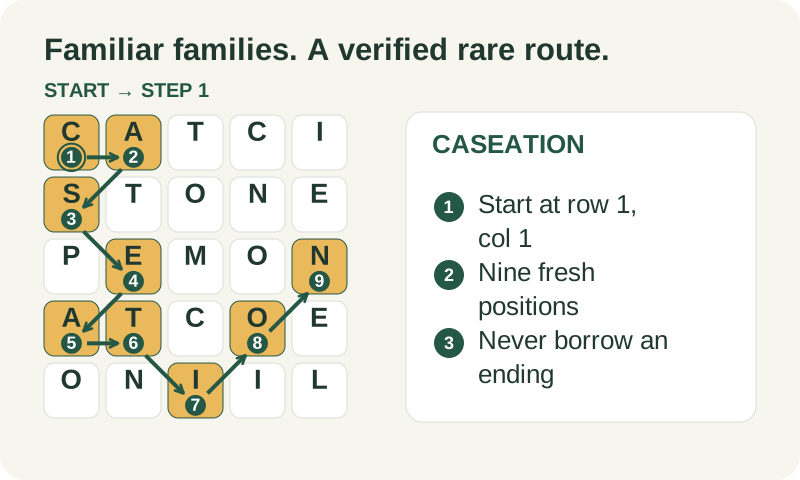
The recorded legal example on this word family practice board is CASEATION. Its row/column route is r1 c1 → r1 c2 → r2 c1 → r3 c2 → r4 c1 → r4 c2 → r5 c3 → r4 c4 → r3 c5. Every position was checked for range, adjacency, distinctness, spelling, and ENABLE membership by the independent validator. This uncommon spelling demonstrates dictionary coverage and legal turns; the family exercise can still begin with familiar bases. Never infer that an ending is available merely because its letters appear somewhere else in the grid. You can select a result in the live tool to compare numbered steps; dictionary validity remains separate from another game’s acceptance.
What to carry into your next attempt
Treat this word family practice board as a controlled lesson supported by traceable paths. Difficulty comes from the documented site-specific evaluation, not a verified human rank or another game’s official mode. Keep version and completion context when reviewing results, and choose one decision to repeat before moving to an unfamiliar board.
Check the selected rules and custom points, word-list source and license, verification methods, and local data and network details when interpreting this example.