Field guide
Choose a Word Hunt board size: 4×4 to 7×7
Match the actual grid, use Custom rules for large boards, and understand partial searches.
Count cells before solving
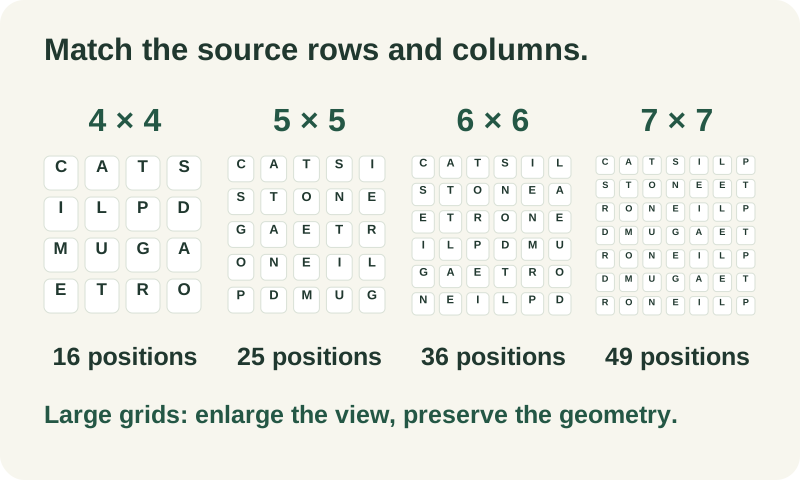
A 4×4 board has 16 tiles, 5×5 has 25, 6×6 has 36, and 7×7 has 49. Paste rows in reading order. Missing or extra tokens should be corrected before solving; an empty tile is not an implicit wildcard. Multi-character QU occupies a single cell.
Open a size-matched workspace
- 4×4 solver: the standard entry board with configurable Custom rules.
- 5×5 solver: 25-cell Custom Word Hunt with full input and path support.
- 6×6 solver: 36 cells with a safe array-based visited map.
- 7×7 solver: 49 cells with board zoom and explicit search-budget status.
More tiles do not guarantee a complete search
Trie prefix pruning skips impossible prefixes, but repeated letters and branching paths can still make a board expensive. Searches run in a Worker and can be canceled. If a time or node budget ends the search, the interface marks the answers as partial. Exporting those answers does not make them complete.
Choose a comfortable training board
Use untimed large-board practice to learn scanning and path reading, then add a timer if useful. Enlarge a 7×7 board on a narrow screen. Difficulty labels come from the site’s measured solution density and word-length mix, not an official game rating. The supported large sizes are Custom modes; availability here does not establish that GamePigeon ships them.
Practical details and worked examples
Grid dimensions describe the actual number of rows and columns, not a promise about a game's official modes. This site supports square 4×4, 5×5, 6×6, and 7×7 boards through the same input, solving, practice, and review workflow. Count your source grid before entering it. Row boundaries determine neighbors even when the letter sequence stays identical.
Count rows and columns before pasting
A 4×4 grid contains 16 positions, 5×5 contains 25, 6×6 contains 36, and 7×7 contains 49. Count both directions on the original image rather than inferring size from a title or screenshot width. A multi-letter tile still occupies one position. Keep row breaks when possible so the preview can be checked against the source. Missing letters require correction; they are not silently treated as arbitrary wildcards.
Open the workspace that matches the board
Use the four-row solver page for a sixteen-cell board and the five-row solver page for a twenty-five-cell board. The pages for different Word Hunt board sizes preselect a real grid and explain that size's input task. They share the same versioned engine, so changing pages is not a way to access a different secret dictionary. For screenshot input, confirm the row count alongside the proposed crop before splitting it into tiles.
Keep large grids within the Custom boundary
The larger Word Hunt board sizes are supported as Custom Word Hunt. This release has not verified them as official GamePigeon modes. Their scores use the site's letter-based formula, and their selected timer is a site setting. The dimensions say how many positions the solver can process; they do not establish a third-party game's word acceptance, Q behavior, timing, or rules. Read the profile rather than assuming brand compatibility from the name.
Balance readable tiles with bounded search
Larger Word Hunt board sizes can create many additional connected prefixes and legal alternatives. Use zoom on a large grid so letter entry and numbered paths remain readable, then return to the full-board context when needed. A search budget can stop before all dictionary words have been examined. Retained partial results remain useful but must be labeled unfinished. Extending the budget or trying another configuration should be an explicit action, not an invisible completeness claim. When reviewing an enlarged region, use its row and column labels to preserve your place before returning to the whole board.
Compare practice attempts of the same size
When comparing Word Hunt board sizes, keep size, board, rules, dictionary version, duration, and pause status aligned when comparing two rounds. A higher total on a larger grid does not demonstrate better performance on the earlier challenge. Smaller regions can still make a large board useful for untimed scanning practice. The Word Hunt solver 4x4 and Word Hunt solver 5x5 examples are starting exercises; advance when the input and movement checks are comfortable, not because more tiles imply a better lesson.
A practical sequence
- Count the source rows and columns and choose that exact size.
- Verify every position, including any multi-letter tile.
- Use zoom for larger grids and read search completion status.
- Keep dimensions and rule versions fixed when comparing practice attempts.
A worked example
Take sixteen letters arranged as four rows. At that size, the first position of row 2 touches the first position of row 1. Pasting the same sequence into a five-column grid shifts that row boundary and changes legal neighbors, even if the text looks familiar. The answer list is then about a different board. Correct the dimensions before investigating missing words. For a 7×7 source, count all forty-nine positions and inspect a magnified region without discarding the full-grid context.
What to carry into your next attempt
Choose Word Hunt board sizes from the source geometry, then keep the selected profile attached to the board. Use large grids as supported custom challenges with honest completion status and readable paths. Size changes are meaningful changes to adjacency and practice difficulty, so verify them before treating two answer lists or scores as comparable.
Check the selected rules and custom points, word-list source and license, verification methods, and local data and network details when interpreting this example.
Updated October 10, 2026 · Independent Word Hunt Solver project