Field guide
A practical Word Hunt training routine
Practice short words, word families, long words, turns, and systematic scanning.
Build an observable routine
Start with an untimed round so the clock does not hide your errors. After the round, inspect missed words and replay their paths. Choose one training goal for the next round, then compare sessions only when size, rules, dictionary, and timer match. A paused round is useful practice but should not be treated as a strict timed record.
Five complementary drills
- Short words: scan for three- and four-letter words before chasing rare long ones.
- Long words: hold a viable prefix in mind and follow its extensions.
- Prefixes and suffixes: check S, ED, ER, ING, RE, and UN only when the required adjacent tiles exist.
- Turning paths: recognize words that change direction or cross diagonals.
- Board scanning: move systematically through start tiles rather than repeatedly inspecting one corner.
Use word families carefully
CAT and CATS may share a path prefix, but adding S is legal only if an unused adjacent S is available. A prefix or suffix is not permission to jump. Our dictionary includes uncommon words, so review high-value omissions while deciding which words you actually want to learn.
Review evidence, not an invented diagnosis
The review compares your submitted words with the same-rule solver output. It can point to missed lengths or word families. It cannot prove where you looked, why you hesitated, or that an unseen word was attainable in your remaining time. This routine is a practical exercise; no controlled improvement or win-rate study has been performed.
Practical details and worked examples
A useful Word Hunt strategy starts with a specific skill and a repeatable challenge. Finding more words can mean recognizing familiar short strings, extending a word family, noticing a legal turn, or checking a region you skipped. Separate those tasks while learning. This guide offers a practice routine you can inspect in review; it does not promise a ranking increase or a particular score improvement.
Establish a baseline you can compare
For a comparable Word Hunt strategy baseline, choose one board size and keep the same dictionary, minimum length, adjacency, Q interpretation, and duration. Play one ordinary round without consulting answers, then finish it and inspect found and missed words. A paused round is useful practice but belongs in its own comparison group. If you are asking how to get better at Word Hunt, begin with what this specific round shows instead of comparing unrelated boards or another game's points.
Build short-word recall before rushing
Start your Word Hunt strategy with the short-word drill to look for three- and four-letter strings around one starting tile at a time. Say a candidate, trace it, and submit it. Distinguish a word you failed to notice from one you knew but could not trace legally. Familiar short words can become reliable starting points for longer families, but accepting a common spelling still depends on the site's dictionary and a valid route on the current board.
Extend families without assuming the suffix fits
After finding a base word, check nearby endings such as S, ED, ER, or ING. Rebuild the entire route for every extension: the new word cannot reuse an earlier cell or jump over a gap. This is a practical Word Hunt strategy because related spellings give you candidates to examine. It is not a rule that every apparent inflection exists in ENABLE or fits the board. Inspect membership and movement separately.
Use turns and long words as separate exercises
For Word Hunt strategy that emphasizes movement, a turning-path drill draws attention to direction changes in submitted routes. A long-word drill rewards keeping a connected prefix alive for additional letters. Learn each untimed before combining it with fast scanning. Useful practical advice include slowing down at repeated letters and checking the exact exit from a center tile, but no particular search order guarantees an exhaustive human round. Review the route that actually caused difficulty.
Finish with one small, repeatable adjustment
Choose two or three missed words, replay their paths, and decide what to change in the next attempt. If most selected misses were short, repeat a short-word drill. If a legal turn surprised you, choose turning paths. If you forgot several starting cells, use the scanning checklist. These Word Hunt tips describe observable review findings; they do not claim to diagnose your eye movements or concentration from data the site never recorded.
A practical sequence
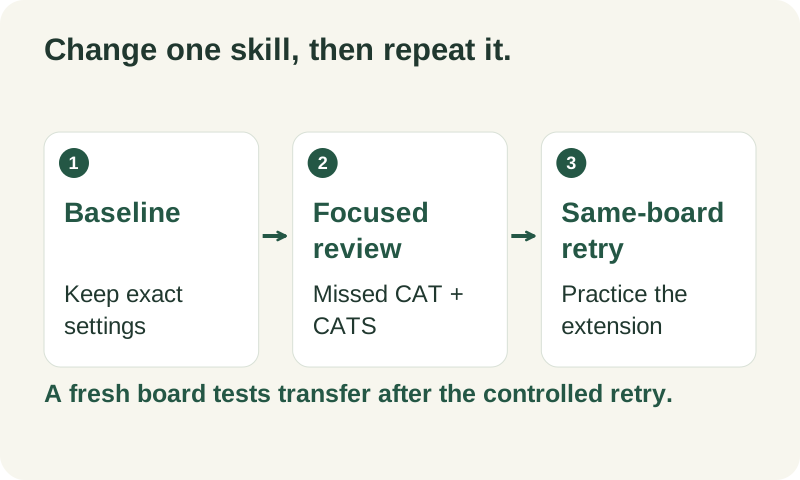
- Fix the board, rules, dictionary, and timer for a baseline round.
- Choose one drill and practice its objective untimed.
- Review a few missed words and follow their exact paths.
- Repeat the same challenge or theme, preserving pause status when comparing.
A worked example
After a 4×4 round, suppose the review shows CAT and CATS as missed words. First trace CAT. Then check whether an unused neighboring S extends the same route, or whether CATS needs an alternate route. Repeat the board with the goal of noticing that family, not merely beating the previous total. If you later ask improve your search on a 7×7 grid, keep the same reasoning while reducing the practice region and using zoom to read it comfortably.
What to carry into your next attempt
Keep Word Hunt strategy grounded in the previous round and the next deliberate action. One board, one rule profile, and one skill make the feedback easier to understand. Use speed after accuracy is reliable, preserve the distinction between paused and strict timing, and treat suggested routines as exercises rather than guaranteed performance gains.
Check the selected rules and custom points, word-list source and license, verification methods, and local data and network details when interpreting this example.
Updated October 10, 2026 · Independent Word Hunt Solver project