Short words
Build a reliable base of three- and four-letter words. Start at each tile and check its immediate neighbors.
Find words with 3–4 letters.
Start this drillOne skill at a time
Each drill is playable in all four board sizes with your choice of timer and rules. The focus changes which submitted paths count. Review explains what was missed; these are practice methods, without a measured promise of game score improvement.
Build a reliable base of three- and four-letter words. Start at each tile and check its immediate neighbors.
Find words with 3–4 letters.
Start this drillExtend legal prefixes a tile at a time. Longer words are useful only when every step stays adjacent.
Find words with at least 6 letters.
Start this drillLook for word families and endings such as S, ED, ER, and ING. Rebuild each word as an independent path.
Find words with common starts or endings.
Start this drillPractice changing direction. Words may turn at any tile; your path cannot use a tile twice.
Find words whose path changes direction.
Start this drillWork through every starting position in rows. A visible start-tile checklist helps you keep track without suggesting answers.
Check every starting tile and find legal words.
Start this drillWord hunt drills narrow a round to a skill you can notice and repeat. Choose short words, long words, prefixes and suffixes, turning paths, or systematic board scanning. Each theme still uses real adjacency, no tile reuse, and the same selected dictionary. Word hunt drills add a target; it does not rewrite the fundamental rules. Start with one objective so that the review tells you what to change instead of presenting an undirected list of everything you missed.
Three- and four-letter targets help you practice immediate neighbors and reliable recall. They are useful when your attention goes straight to long words and skips easy starts. Search from one tile deliberately, then move to another. A duplicate word does not become a second discovery because you draw a different path. Focus on recognizing distinct spellings quickly while keeping each submitted route legal and the selected minimum word length unchanged.
Long-word practice asks for at least six letters. Keep a plausible prefix in mind and examine its next adjacent options without revisiting earlier positions. The prefix is a search aid, not proof that the final spelling belongs to the dictionary. A multi-letter tile can supply two or three letters in one step, so a long target does not always require the same number of visited cells. Check assembled letter count, not visual path length alone.
Family practice looks for common starts and endings such as RE, UN, S, ED, ER, or ING. Find a base, then investigate the neighbors near its route. Every extension needs its own valid path and membership check. You cannot borrow a distant suffix or revisit the same tile just because the word family is familiar. A missing extension may indicate absent geometry rather than a failure to remember a common ending.
Turning practice checks the exact route submitted. A diagonal straight line is not automatically a turn; direction must change between steps. Scanning practice provides a starting-position checklist you control. Marking a start as checked records your attention, not a claim that you exhausted every possible prefix there. Word hunt drills target different gaps: following flexible routes versus avoiding regions that you never inspect.
Pick a target that matches your last review. If you missed many short neighbors, do that theme before increasing size. If you found bases but not endings, work on families. Finish these word hunt drills, inspect a missed target, and retry the same board. Later, combine the learned habit with ordinary practice. A coherent word hunt strategy grows from specific decisions that survive a new board, not from an impressive score on one memorized example.
On a turning drill, CAT submitted straight across a row is a valid word but does not satisfy a direction-change target. CAT drawn right from C to A and then down to T changes direction and can satisfy the target if all positions are distinct and adjacent. The spelling alone cannot tell those cases apart. That is why word hunt drills evaluate either letters or the exact route according to the chosen theme.
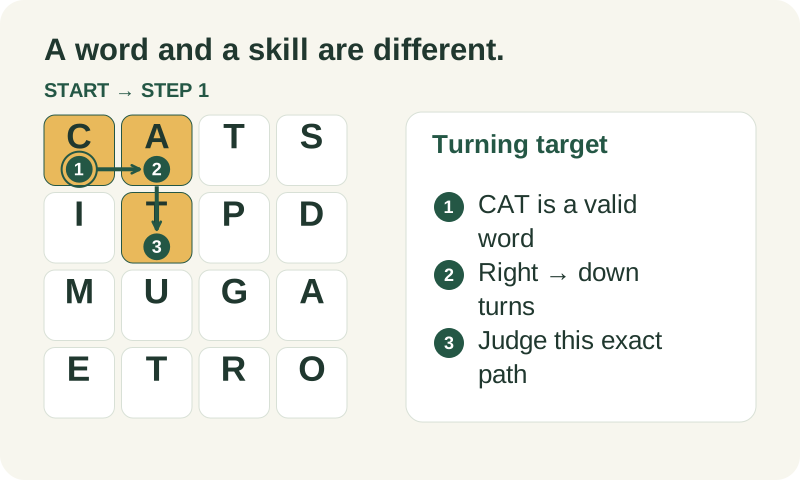
In word hunt drills, keep the target narrow enough to measure. A short-word round, a suffix exercise, and a scanning checklist answer different questions about your behavior. Use ordinary play to combine them only after you can explain which decisions changed. Review and replay preserve that explanation better than an unexplained total or an unverified comparison with other players.
Check the selected rules and custom points, word-list source and license, verification methods, and local data and network details when interpreting this example.